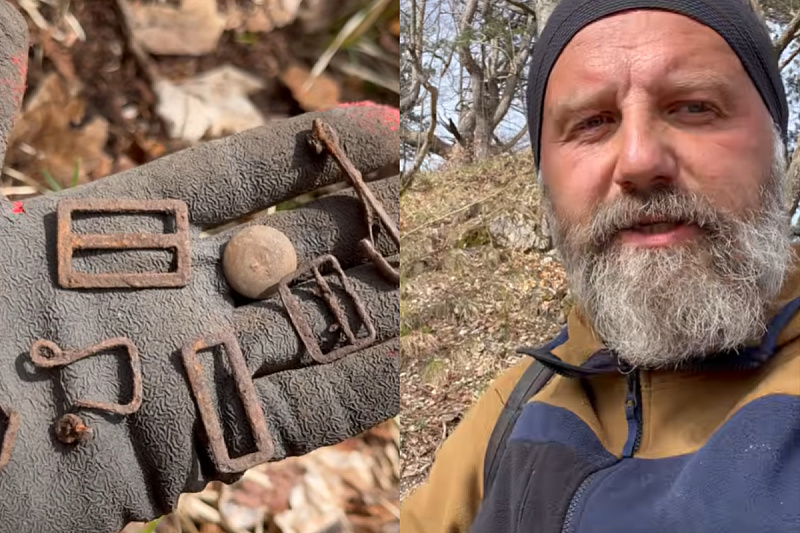
As he noted, he spent two years searching for the place where history had stopped. "Every excavated piece of land was a hope that I would piece together the mosaic. This was not just a search; it was a debt to man and to history that must not remain unresolved. When I found the boot, I knew it was the moment when Prenj decided to speak," he said. Džino documented the entire process with a camera and recorded a video showing him finding cartridges and fragments from Italian hand grenades and other items that could belong to Španović. Džino also found a button that he said might be from Ilija Španović's greatcoat. "Here is the buckle as well. This is also something military. I'm not sure, but I think this could be a good sign. This is definitely the place where the uniform decayed. Whose, I don't know. One definitely decayed here, and that is Ilija Španović's," he recounted in the video. Džino found all the mentioned items nearby. In the video, he also mentioned that he called a friend, an expert on World War II artifacts, who told him that the items were definitely a trouser buckle, while the button was from a greatcoat from the period of the Kingdom of Yugoslavia. He also found a shoe sole and other parts of footwear, as well as bones that he claims belong to Ilija Španović. "Human bones in the boot. Toes. I found the remains of a national hero. I found the remains of Ilija Španović on April 12, 2026. Eighty-three years and one month, the same place. The Chetniks were here, they let the Partisans come, and here Ilija Španović was killed. Here is Ilija's body. That is the main reason why he was not buried. His body remained in front of the Chetnik positions, and the Partisans could not approach him," he recounted in the video. He left the bones at the discovery site and will inform the police about everything. He added that he believes enough has been found for DNA analysis. Ilija Španović was born on April 30, 1918, and was killed on Mount Prenj during World War II in 1943. He was a participant in the National Liberation Struggle and a national hero of Yugoslavia. He died during the Fourth Enemy Offensive when, after crossing the Neretva River on March 10, 1943, his battalion on Mount Prenj was suddenly attacked by Chetniks. By decree of the Presidency of the National Assembly of the Federal People's Republic of Yugoslavia on December 20, 1951, Španović was declared a national hero.
Society
B&H photographer in Prenj discovered objects and bones that could belong to the national hero Ilija Španović.
Photographer Dženad Džino from Jablanica has discovered remains and items on Mount Prenj that may belong to Ilija Španović, a national hero from World War II, and he shared the entire story on his YouTube profile.
ingestion