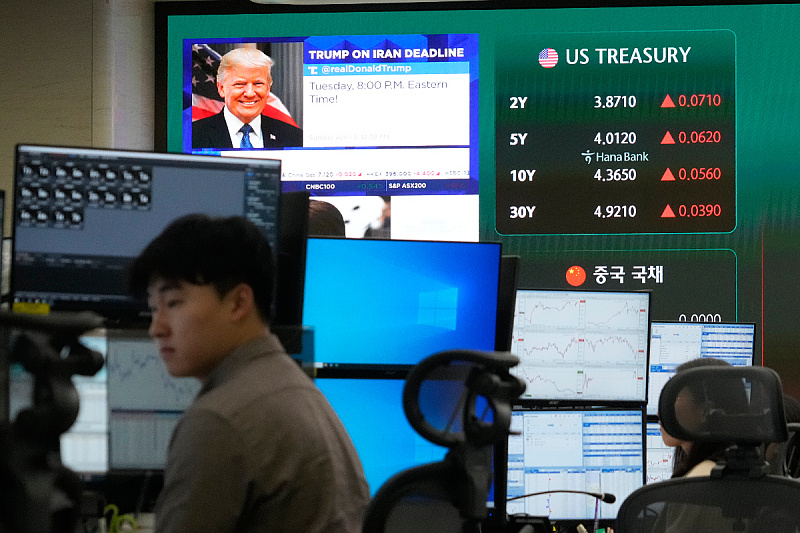
Japan's benchmark Nikkei 225 index rose nearly 1.1% to 53,692.42 points in morning trading. South Korea's Kospi gained 1.5% to 5,460.24 points. Trading in Australia was halted for Easter, and in Hong Kong and Shanghai due to a traditional Chinese holiday.
Also notable is the Tuesday deadline given by Trump to Iran to open the Strait of Hormuz. Some analysts fear that the war could further escalate afterward. Over the weekend, Trump issued new threats to Iran, even as bombings in the region continued. The United States rescued two pilots whose fighter jet was shot down by the Iranian military.
The key market focus remains oil prices.
U.S. benchmark crude oil rose by 38 cents to $111.92 per barrel. Brent, the international standard, added $1.71 to reach $110.74 per barrel. Energy markets were closed on Friday, but prices have been rising sharply in recent days due to fears that the war in Iran will last longer than expected.
The U.S. relies on the Persian Gulf for only a small portion of its oil imports, but oil is a globally traded commodity, and prices are formed on the world market. Some countries, such as resource-poor Japan, cover a large part of their energy needs through imports and heavily depend on access to the Strait of Hormuz.
"As we enter the first full trading week of April, the word uncertainty is key. Last year it was associated with the impact of tariffs due to 'Liberation Day,' this year it is the uncertainty surrounding the ongoing war in Iran," said Jay Woods, an analyst at Freedom Capital Markets in New York.
U.S. markets were closed on Good Friday and will reopen on Monday. Some markets in Europe also did not trade on Friday.
In currency markets, the dollar slightly strengthened to 159.65 Japanese yen on Monday from 159.63 yen. The euro was worth $1.1509, down from $1.1517.