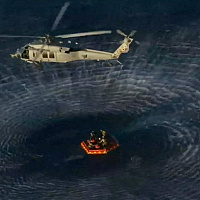
NASA's Orion capsule, named Integrity, gently parachuted into the sea off the coast of Southern California around 2 a.m. local time. This marked the conclusion of a 10-day mission during which astronauts successfully traveled deeper into space than ever before.
The Artemis II flight, which covered a total of 1,117,515 kilometers in two Earth orbits and featured a climactic lunar flyby about 4,000 miles from the Moon's surface, was the inaugural crewed test flight. Its goal is to return astronauts to the lunar surface starting in 2028.
The landing was broadcast live via NASA's video feed, and the four crew members—Reid Wiseman, Victor Glover, and Christina Koch from NASA, along with Canadian Space Agency astronaut Jeremy Hansen—were extracted from the capsule in the sea and then taken to a recovery ship, where they will undergo medical examinations.
Their team also designed some motor skill tests that the astronauts will undergo as part of the health checks awaiting them.
The crew's return home was the riskiest test of the mission and its Lockheed Martin-built spacecraft, proving that the capsule's heat shield can withstand the extreme forces of re-entry into the atmosphere from a lunar return trajectory.
The capsule plunged into Earth's atmosphere at 32 times the speed of sound, with atmospheric friction hitting its heat shield at temperatures around 5,000 degrees Fahrenheit or 2,760 degrees Celsius.