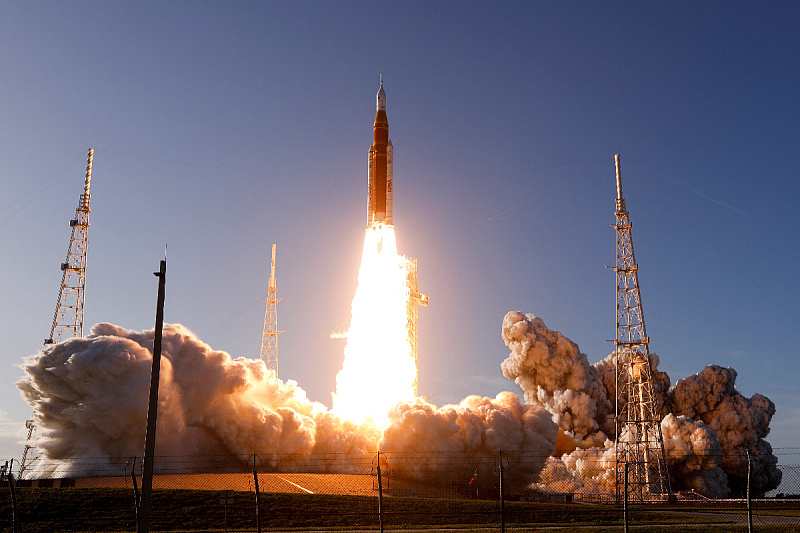
"The Artemis II crew is safe, protected, and in excellent spirits," NASA announced following the spectacular launch of the mission to the Moon. The Artemis crew sent a message stating it was "a great day." The four-member crew has embarked on an approximately ten-day journey during which they will orbit the Moon but will not land on its surface. Instead, the mission aims to test all key systems of the Orion spacecraft under crewed conditions. The Space Launch System (SLS) rocket, the most powerful NASA has ever built, was launched after extensive preparations. During earlier launch attempts, there were technical issues, including a hydrogen leak, which caused delays. However, the latest launch proceeded successfully without major complications. The Orion spacecraft is designed to withstand the extreme conditions of deep space and safely return the crew to Earth. During the mission, astronauts will test navigation, communication systems, flight control, and life support systems—all key components for future, more complex missions. <style>.embed-container { position: relative; padding-bottom: 56.25%; height: 0; overflow: hidden; max-width: 100%; } .embed-container iframe { position: absolute; top: 0; left: 0; width: 100%; height: 100%; }</style><div class="embed-container"><iframe src="https://www.youtube.com/embed/m3kR2KK8TEs" frameborder="0" allowfullscreen></iframe></div> The flight path includes orbiting the Moon and returning to Earth, which will enable NASA to gather valuable data on spacecraft performance and the impact of the space environment on humans. The crew consists of astronauts from the United States and Canada, making this mission an important international endeavor as well. Their experience and work during the mission will help prepare for the next phases of the Artemis program. This mission is a prelude to Artemis III, a planned mission during which astronauts are expected to land on the Moon again, including the first woman and the first person of color on its surface. The Artemis program aims to establish a long-term human presence on the Moon, including building infrastructure that would enable further space exploration and potential missions to Mars. <b>Expected Issues at the Start of the Mission</b> The Artemis II crew has already discovered after launch that even a trip to the Moon comes with very common problems. In addition to toilet issues, the astronauts discovered several other problems with their brand-new spacecraft. A valve connecting two sets of water tanks was found closed when it should have been open—likely forced shut by a powerful water surge—and had to be reset. Engineers also observed a recurrence of a minor electronic issue from Artemis I, where one component briefly failed after a radiation strike before automatically recovering. None of these issues are classified as a threat to the mission, but they highlight why Artemis II is largely a test flight. <b>Who Makes Up the Crew and What Is the Ultimate Goal</b> Unlike the inaugural Artemis I mission, which carried only mannequins and sensors, the modern Orion capsule contains a carefully selected team: - Reid Wiseman (50), Commander: A NASA veteran and former commander of the International Space Station (ISS), a test pilot with extensive experience. - Victor Glover (49), Pilot: A U.S. Navy aviator making history as the first Black person assigned to a lunar mission. - Christina Koch (47), Mission Specialist: Holds the absolute record for the longest single spaceflight by a woman (328 days) and a veteran of numerous spacewalks. - Jeremy Hansen (50), Mission Specialist: A former fighter pilot and the first Canadian to travel toward the Moon, representing a symbol of international cooperation in this project. The name "Artemis" carries strong symbolism; in Greek mythology, she is the twin sister of Apollo and the goddess of the Moon. While the legendary Apollo missions (1961–1972) culminated in the first human steps on the lunar surface, Artemis has even greater long-term ambitions. The success of tonight's mission will directly pave the way for Artemis III (planned for 2027) and Artemis IV (early 2028), which is expected to bring the first human landing on the Moon since the Apollo 17 mission, targeting the lunar south pole where water is believed to exist in the form of ice. The ultimate goal of the Artemis program, alongside establishing a permanent base on the Moon (through the Artemis V mission by late 2028), is to prepare the technology and humanity for the greatest endeavor in human history: sending the first people to Mars.
Society
Artemis II mission astronauts launched on historic journey around the Moon
NASA has successfully launched the Artemis II mission, marking the first human journey to the Moon in over half a century. This mission represents a crucial step in efforts to return humanity to the Moon and eventually head toward Mars.
ingestion