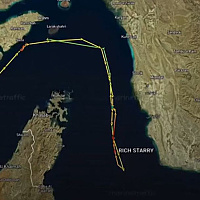
The vessel "Rich Starry," carrying 250,000 barrels of methanol to Oman's Sohar port, abruptly changed course after reaching the Gulf of Oman, which is patrolled by dozens of U.S. warships. It altered its destination "under orders." It was set to become the first ship to pass through the critical oil passage since the U.S. president imposed a blockade on Monday, stating he would "eliminate" any Iranian vessel attempting to breach it. On Tuesday, U.S. Treasury Secretary Scott Bessent said Chinese tankers would not be allowed passage through the strait, meaning they "will not be able to access their oil." Earlier that day, Beijing criticized the blockade, calling it "dangerous and irresponsible." The "Rich Starry" had loaded its cargo in the United Arab Emirates and was not expected to be covered by the blockade, which was intended to apply only to vessels using Iranian ports. The ship and its Chinese owner, Shanghai Xuanrun Shipping Co Ltd, were sanctioned by the U.S. in 2023 for dealings with Iran. Trump's move signals he is taking a hardline stance on the blockade and is willing to confront Chinese leader Xi Jinping ahead of his planned visit to Beijing in a month, writes The Telegraph. "Turning back the Rich Starry would be the most significant blockade action since Kennedy confronted Khrushchev during the Cuban Missile Crisis," said Michael Rubin, a former Pentagon official. Trump has "reversed the power dynamic that Xi established during the disastrous Anchorage summit" in 2021, when Chinese officials rebuked senior U.S. officials, he added. On Tuesday, a spokesperson for China's Foreign Ministry said this move would "only escalate tensions and undermine the already fragile truce" between the U.S. and Iran, adding: "This is dangerous and irresponsible behavior." Saudi Arabia is also pressuring the U.S. to back down, fearing Iran could retaliate by blockading the Red Sea and paralyzing its economy. Crown Prince Mohammed bin Salman is urging Trump to lift his maritime quarantine of Iranian ports in the Gulf and return to negotiations, Gulf diplomats said. Saudi lobbying reflects Riyadh's concern that Tehran might retaliate against the U.S. blockade by instructing its Houthi allies in Yemen to close the Bab al-Mandeb Strait, a narrow chokepoint in the Red Sea through which much of the kingdom's oil supplies pass. U.S. Central Command stated the blockade would be "enforced impartially against vessels of all nations entering or leaving Iranian ports and coastal areas." In the first 24 hours of the blockade, enforced by over 10,000 U.S. troops along with 15 warships and dozens of aircraft, no ship managed to pass, it was reported, adding: "Six merchant vessels complied with instructions from U.S. forces to turn around and re-enter Iranian ports in the Gulf of Oman." On Tuesday, Bessent criticized China for its conduct during the U.S. and Israel's war with Iran, which caused oil prices to spike by about 50 percent. He accused Beijing of being an "unreliable global partner" for hoarding oil reserves instead of helping alleviate the global shortage caused by Iran's closure of the Strait of Hormuz, which accounts for 20 percent of the world's oil and gas flow.
Society
Americans return sanctioned Chinese ship from the Strait of Hormuz: This hasn't happened since the Cuban Missile Crisis.
Americans today returned the sanctioned Chinese tanker, which entered the Strait of Hormuz yesterday, appearing as if Chinese leader Xi Jinping was testing Donald Trump's blockade.
ingestion