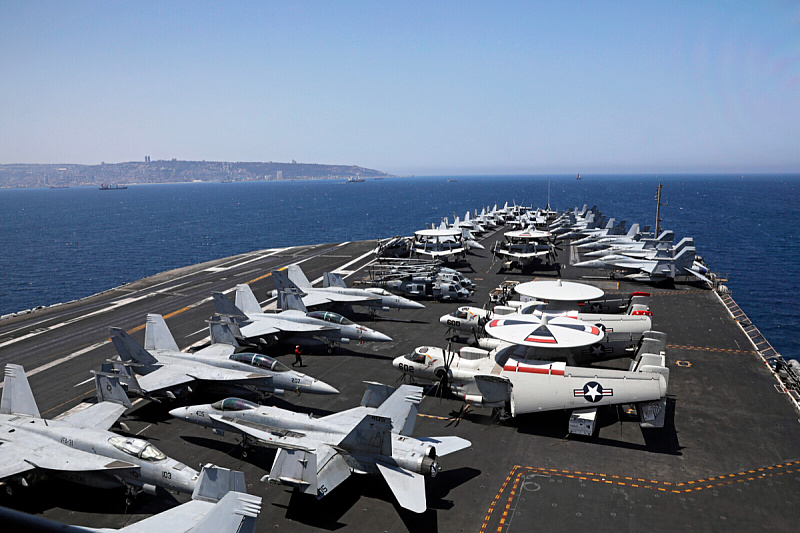
The USS George H.W. Bush, deployed in late March, did not transit the Strait of Gibraltar and enter the Mediterranean Sea, the typical route for East Coast-based carriers heading to the Middle East. Instead, the carrier and its escorts, which include the guided-missile destroyers USS Donald Cook (DDG-75), USS Mason (DDG-87) and USS Ross (DDG-71), are sailing around Africa, two defense officials confirmed to USNI News on Monday. The fast combat support ship USNS Arctic (T-AOE-8) is also operating with the Bush carrier strike group.
The route around Africa allows the carrier and its escorts to avoid transiting the Red Sea and the Bab el-Mandeb Strait, which have been focal points for Houthi drone and missile attacks on U.S. and commercial shipping throughout 2024 and 2025.
The Bush’s transit around Africa comes as the United States is initiating a blockade of the Strait of Hormuz following President Donald Trump’s announcement on Sunday.
U.S. Central Command then issued a statement explaining how U.S. forces will enforce the blockade of this key shipping chokepoint, which has been a major flashpoint since the U.S. and Israel launched a war against Iran in late February.
A notice to mariners issued Monday, obtained by USNI News, states that a so-called “grace period,” which allowed neutral ships in Iranian ports to leave the area, expired at 10 a.m. Eastern time on Monday.
“After that time, any vessel entering or exiting the blockaded area without authorization is subject to interception, diversion and seizure. Neutral vessels may still be subject to visit and search to determine the presence of contraband. Humanitarian shipments, including food, medical supplies and other goods necessary for the survival of the civilian population, will be permitted subject to inspection,” the notice reads.
During a Monday appearance at the Atlantic Council, Chief of Naval Operations Adm. Daryl Caudle spoke about the challenges of the Hormuz blockade, including the risk of mines, contested airspace and the question of whether allies will join the blockade.
“I mean, this is a big undertaking that has to be enforced to be effective. And of course, all of that is bounded by the legal framework, rules of engagement and legal aspects that allow the enforcement of a blockade,” Caudle said.
A U.S. aircraft carrier has not transited the Bab el-Mandeb since USS Dwight D. Eisenhower (CVN-69) sailed through the strait in December 2023, shortly after the Houthis began their campaign of attacks on shipping in the Red Sea. U.S. destroyers that have transited the Bab el-Mandeb in recent years have faced persistent Houthi attacks.
Before Trump announced the blockade, two U.S. guided-missile destroyers transited the Strait of Hormuz and briefly operated in the Persian Gulf on Saturday, several days after the Trump administration announced a two-week ceasefire with Iran, as U.S. and Iranian officials continued negotiations.
USS Frank E. Petersen (DDG-121) and USS Michael Murphy (DDG-112) entered the strait to begin “setting conditions for mine clearance,” USNI News reported at the time. Negotiations between Iran and the U.S. broke down late Saturday, according to reports.