Even owners who have driven the same car for years without major issues are noticing that maintenance is more expensive, and the new replacement parts they buy and install last less time than the original ones. The hourly rate for mechanics has meanwhile risen to such an extent that in some service centers it costs more than an hour of a lawyer's time—and it is well known that lawyers do not work at very affordable prices. However, what is truly concerning is the practice where service centers slip car owners a list of expensive, completely unnecessary procedures, just to sell as many parts as possible and charge for as much work as possible.
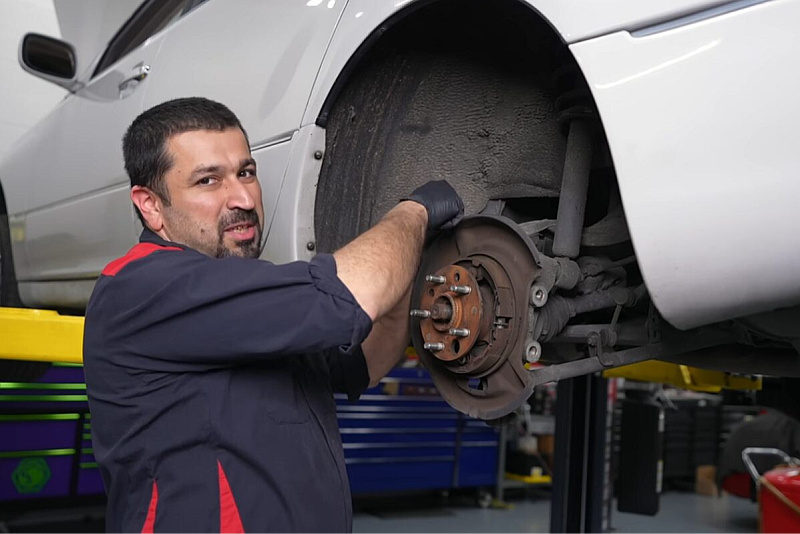
An American mechanic and also a service center owner, on his YouTube channel The Car Care Nut, opened up about how the entire industry has fallen into unprecedented greed, losing all sense of fairness toward customers. He is a man with decades of experience, specializing mainly in Toyota and Lexus, and the author of one of the first YouTube channels dedicated to vehicle servicing. He is known for his measured and practical approach, along with constant attention and a relationship-oriented attitude toward clients.
He says that in recent years he feels that fear has become increasingly ingrained in the public, and that going to an unfamiliar service center can result in a huge and completely unjustified bill, along with a long list of urgent interventions and astronomical prices.
"My job is not to sell parts" He himself confirms that this fear is not unfounded. Unfortunately, the perception is accurate, and it is a direct result of the way more and more service centers operate today.
"Sales, sales, sales—that is what an increasing number of service centers revolve around, where mechanics are rewarded for selling as many services and parts as possible, just to inflate the bill to the maximum," he explains.
He simultaneously asks himself: "Are we mechanics even in the service business, or have we become salespeople?"
Many service centers act as if they are in a constant sales frenzy.
"When did we stop waking up in the morning and going to work to fix cars, and start waking up only to make another sale?"
"My job is not to sell parts. My job is to fix cars and advise clients from my professional perspective. In the end, they are the ones who make the decision, not me."
A client as an example of typical greed As a concrete example, he cites the case of one of his regular clients, who consistently and faithfully comes to his service center. The last visit included a thorough service, which also involved changing the transmission fluid. This client always schedules an appointment in advance, several days earlier.
However, before the next oil change, he did not have enough time, and he also had a long trip ahead. He couldn't make it to his usual service center, so he decided to stop by an authorized service center along the way, solely for an engine oil change—nothing more.
The service center took the car, and shortly afterward presented a list of "urgent recommendations": transmission fluid change, coolant change, brake fluid change, differential and transfer case fluid change, air conditioning refrigerant recharge, PCV valve replacement, and intake manifold cleaning.
The car had about 200,000 kilometers on it at the time. The owner refused all additional procedures, said he would have them done by his mechanic, and insisted only on the oil change.
He then called the mechanic from this story and asked him why the service center was recommending so much when a good portion of the mentioned fluids and procedures had recently been replaced by him. It turned out that none of the service staff had even attempted to ask or check whether any of the listed items had already been done. They simply started selling as many parts and services as possible.
The mechanic says that many service centers have completely forgotten how to ask a client in a normal conversation whether they have already done something or not, out of genuine concern for the car's condition. And when the owner says they did it 10,000 km ago, the only correct response is: "Great, then we skip that." Such a conversation builds trust because it stems from good intentions, not from a desire to slip something in.
And that is precisely the huge problem that has brought the entire industry to where it is today. A race for sales, not for long-term customer loyalty. The mechanic believes this is a short-term strategy—it brings quick profits but slowly destroys the business. He is convinced that the service center that recommends only what is truly necessary and genuinely cares about the vehicle's condition, without imposing unnecessary procedures, wins clients who always return. Such a client is ultimately more valuable and satisfied because cars always need some kind of maintenance or repair.
The mechanic also reflects on the practice of free services bundled with others, particularly free inspections and diagnostics, considering it equally harmful. Such an approach, he says, leads to the devaluation of mechanics' work and turns into a kind of permission to "fish" for new problems that will fill the bill as thick as possible. In practice, this means superficial inspections with the sole purpose of finding quick and profitable procedures.
The same goes for discounts. Some service centers deliberately raise the initial price just so they can then offer discounts.
"It is much more honest from the very beginning to state a reasonable and realistic price," says the American mechanic.
"When a car doesn't need any procedure, I will say so to the owner without hesitation. That day, I didn't earn anything. But I earned their trust. Unfortunately, few service centers do that," he adds sadly.
The same applies to cars whose value is so low that the necessary repairs far exceed the price of the vehicle itself. One should also be honest with such customers.
"Service centers that choose an honest relationship will never lack customers. Because when you gain someone's trust, you also gain their loyalty."
An example from his own practice One of his mechanics made a mistake while installing a timing chain on a Toyota Corolla, which resulted in a destroyed engine. It would have been possible to quickly cover up the issue by installing new parts and hiding the traces.
Instead, he found and bought the best available used engine, completely refurbished it, paid for a replacement car for the client during that time, and then handed over the vehicle with the rebuilt engine.
"It was an immediate blow to the business, but the only right thing to do. And that is exactly how reputation is built. Unfortunately, the entire industry is increasingly turning toward the sales race and moving further away from genuine concern for clients," he concludes with bitterness.