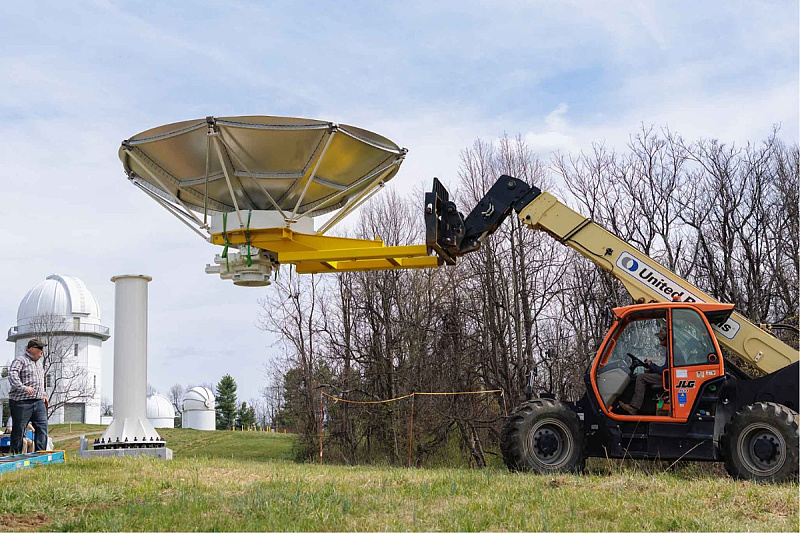
The German DSA-2000 radio telescope, with a diameter of five meters, has officially arrived at the Fan Mountain Observatory of the University of Virginia in the United States. After a three-week journey across the Atlantic and a delicate three-hour forklift transport along a one-way path, the instrument is now settling into its role as the latest hunter of dark matter.
Space is a crowded place, but most of it remains hidden. Astronomers know dark matter exists because its gravity pulls galaxies like an invisible leash, yet it refuses to reflect, absorb, or emit light. "The universe is made of particles. One of these particles we call 'dark matter,' and that's intentionally provocative. We don't know what it is, but it acts gravitationally, influencing the universe in a detectable way. However, it doesn't interact with light in the same way as protons, neutrons, and electrons. We can't see dark matter with our eyes or light, but we can see it gravitationally," said Brad Johnson, an associate professor of astronomy.
To bridge this gap, Johnson and his team are searching for axions. These are hypothetical particles that behave like dark matter. They are "ghosts in the machine of the cosmos." These particles are difficult to find, but there is a trick. The action of a large magnet converts them into "microwaves," which experts can actually measure.
Instead of trying to build a giant magnet on Earth, the UVA team is looking for the largest magnets in the natural world: neutron stars. Neutron stars are ultra-dense remnants of massive exploded stars, possessing titanic magnetic fields that act as cosmic traps.
Astronomers believe these cosmic magnets are perfect places to find axions, which are otherwise nearly impossible to detect. When invisible axions drift through these powerful fields, the particles transform into faint signals, specifically axion decay signals.
The DSA-2000 is uniquely tuned to "catch" these specific signals, enabling astronomers to discover otherwise invisible particles. "We know where some neutron stars are, so we can observe them. We can also search for them in places where they should be, given our understanding of star formation. It's like fishing. You can't see all the fish, but you can guess where they are if you know the lake well enough," said Johnson.
The telescope's journey to the summit was a feat of manual precision. Accompanied by graduate students and researchers walking alongside to avoid leaning trees and hanging vines, the antenna moved "slowly and gently."
A $249,850 grant from the Jefferson Trust powers the mission, turning this hardware into a high-tech scout for the unknown. By focusing on known populations of neutron stars, the team hopes to turn the invisible into a measurable buzz of microwave data.
If the mission succeeds, this telescope will go beyond simple observation to identify the mysterious forces that connect every star and galaxy.