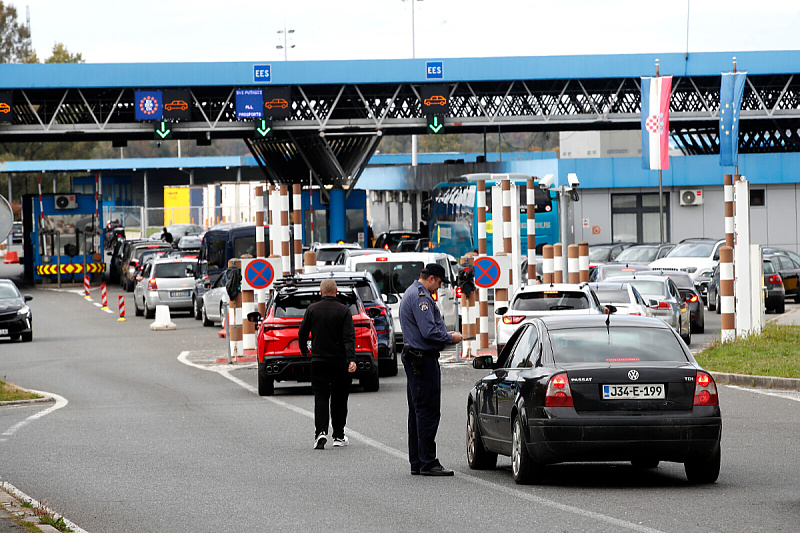
The European Union has decided to implement the EES system to improve the management of external borders and ensure compliance with the prescribed duration of stay in member states.
The system has been applied at all international border crossings since October 12, as well as at those border crossings temporarily designated for international traffic under the Agreement between the Republic of Croatia and Bosnia and Herzegovina. As of today, April 10, the system is fully operational.
Special lanes at borders for third-country nationals
At border crossings, there are special EES entry/exit lanes primarily for third-country travelers subject to the EES system (nevertheless, the system will be operational at all entry/exit lanes during periods of high congestion and peak loads when it will be necessary to use other lanes for EES purposes).
EES applies to certain third-country nationals entering or exiting the Schengen area. Exempt from application are travelers holding residence cards, residence permits, or long-stay visas, as well as holders of border crossing permits, and other exceptions listed in the EU Regulation.
The EES system does not apply to citizens of the European Union, including citizens of the Republic of Croatia, regardless of their place of residence.
What does the EES system record?
EES electronically records the time and place of entry and exit of third-country nationals authorized for short-term stays in EU member states and calculates the duration of permitted stay.
What does data collection at the border look like?
Upon first entry after the establishment of the EES system, in addition to travel document data, biometric data is collected—fingerprints of four fingers of the right hand and a facial image (a personal EES file is created, along with a corresponding note on the time and place of entry/exit).
Upon re-entry, the traveler's identity is biometrically verified by comparing a live-captured facial image with previously stored data.
When exiting the Schengen area, the identity of third-country nationals will also be biometrically verified by comparing a live-captured facial image, along with travel document verification.
Children under 12 years old are exempt from fingerprinting, while facial images are taken regardless of age.
If traveling by air:
Self-service EES kiosks are located at six airports in Croatia: Zagreb, Split, Dubrovnik, Pula, Zadar, and Rijeka.
The kiosks are intended for third-country nationals entering the Schengen area for the first time and who do not yet have a traveler file created, who are not holders of residence permits, residence cards, long-stay visas, and do not belong to other exempt categories under Regulation (EU) 2017/2226.
What does the process at the kiosk look like?
The traveler undergoes pre-registration at the kiosk, which includes: scanning the travel document, capturing facial biometrics and fingerprints of four fingers of the right hand, and a short questionnaire on the purpose of arrival.
How long is data stored in EES?
Personal data of certain third-country nationals (personal EES file with corresponding entry and exit notes) are generally stored for three years after the last exit from the Schengen area, after which they are automatically deleted, while personal data of certain third-country nationals who have not left the territory of member states within the permitted stay period are stored for five years.
It is expected that the duration of border control at road border crossings will increase because certain third-country travelers will have to exit their vehicles upon first arrival after implementation to create a personal EES file and later for identity verification.
Waiting times are expected to decrease after the system becomes more established and a larger number of personal EES files are created.