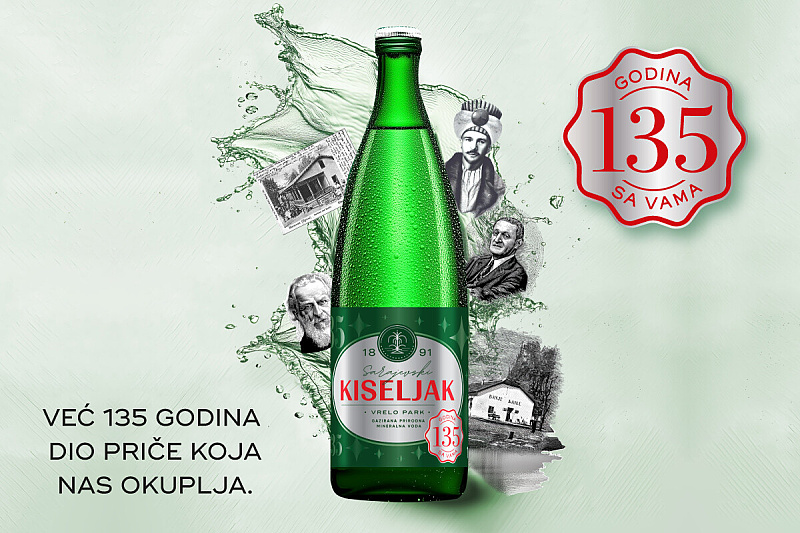
Long before the first bottles were filled and sent to market, the story of Kiseljak water was already written in history. Its springs were known and used by the Romans, who left coins as symbols of hope and luck. Later, Ottoman travelers called it Ekşi su, while Austro-Hungarian explorers spoke of Sauerbrunnen—water whose composition intrigued and healed, and whose reputation crossed regional borders.
The real breakthrough came in 1891, when organized exploitation and bottling of this mineral water began. At a time when Bosnia and Herzegovina was just building its modern foundations, Sarajevski Kiseljak was already traveling far, all the way to Dalmatia, Styria, and even Bombay. It was the start of an industrial and social story that would outlive eras.
To understand just how long 135 years truly is, it’s enough to recall that Sarajevski Kiseljak emerged alongside key symbols of Sarajevo and Bosnia and Herzegovina. The City Hall was just beginning to take its recognizable shape, the National Museum was opening its doors, and the first railway lines were connecting cities and people. Through all those changes—shifts of empires, states, wars, and new societies—one thing remained constant: a glass of Sarajevski Kiseljak on the table.
The water that survived eras and remained the same.
Its development was not linear, but it was persistent. From humble beginnings and manual bottle filling, through the growth of spa tourism and health resorts, all the way to strong industrial production and modern technologies, Sarajevski Kiseljak grew alongside society. One key moment occurred in the 1930s, when hydrogeologist Josip Bać saved the spring from drying up and secured the long-term future of production. Without that move, this story might not exist today.
Today, Sarajevski Kiseljak is much more than a local product. It is a company that produces tens of millions of liters of beverages annually, with products finding their way to markets worldwide—from Europe to North America and the Middle East. Although the assortment has expanded and adapted to modern habits, natural mineral water remains the heart of the brand, what generations recognize it by.
Yet perhaps the greatest value of Sarajevski Kiseljak lies not only in its longevity or market success, but in the role it plays in people’s daily lives. It has been and remains present in small but important moments—family lunches, coffee conversations, gatherings, celebrations, and major events. Through it all, it has become a quiet but constant link between generations.
As a socially responsible brand, Sarajevski Kiseljak continuously invests in the community, supporting sports, culture, and local development. In this way, its story is not just a business one, but a social one—a story of connecting people.
In this milestone year, the company also introduced a new label edition, symbolically marking 135 years of existence. The new visual and slogan, “For 135 years, part of the story that brings us together,” are not just a marketing message—they are a reminder of the continuity, trust, and emotion this brand carries.
Because, 135 years later, from the same spring, the same water still flows—the water that inspired travelers, doctors, and generations of consumers. In a world that is constantly changing, Sarajevski Kiseljak remains that rare thing that connects the past, present, and future.
And perhaps that is its greatest strength: it is not just water we drink, but a story we live.