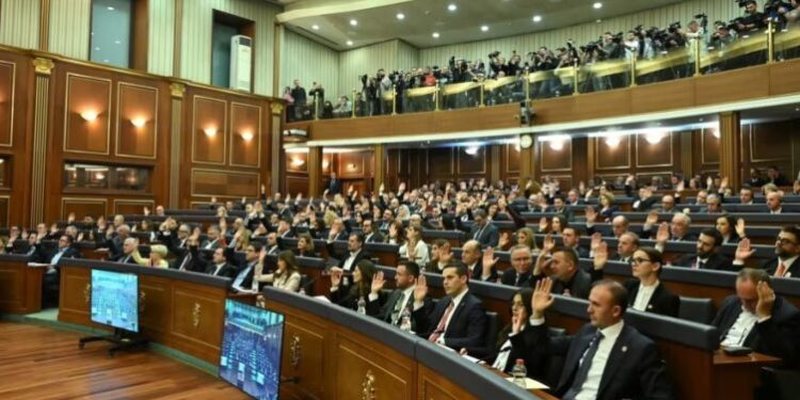
Kosovo's main political parties have yet to make any moves toward reaching a potential agreement on electing the country's new president, despite one week already passing of the approximately one-month deadline set by the country's highest court on this matter.
Last week, the Constitutional Court gave lawmakers 34 days to elect the head of state, otherwise the country will go to early elections, which must be held within 45 days.
The term of the current president, Vjosa Osmani, ends on April 4, and lawmakers now have until April 28 to appoint her successor.
However, since the ruling on this deadline was issued, seven days have passed, and no public actions have been seen toward finding a solution or reaching an agreement on the president.
Sources from Radio Free Europe (RFE) within the two largest opposition parties, the Democratic Party of Kosovo (PDK) and the Democratic League of Kosovo (LDK), confirmed that they have not yet accepted meeting invitations from Prime Minister Albin Kurti, the head of the ruling party, Vetëvendosje.
The PDK said they are organizing a meeting of the Steering Council and that this body "will determine the party's official positions regarding political developments in the country."
"After this internal process, the PDK will come out with a clear and unified position on the next steps," said an official from this party.
Two days ago, Prime Minister Kurti warned that he would send invitations to political party leaders but did not specify when.
He added that he would do so after "internal consultations," without providing further details.
"As important as it is to treat this urgently, it is equally important to succeed. Because, ultimately, we will not be measured by the efforts we make, but by the success we achieve," Kurti emphasized on March 30.
Political analyst Dritëro Arifi told RFE that Vetëvendosje should withdraw its two proposed presidential candidates, Glauk Konjufca and Fatmire Mullhaxha-Kollçaku, to create space for discussions with other parties.
"The essence is whether they will send preliminary signals, as I said, by removing those candidates. They need to 'step back' technically, so that space is created for more serious negotiations," Arifi emphasized, adding that this way discussions could take place in a spirit of compromise.
The election of the new president failed at the beginning of last month precisely due to the lack of an agreement between the parties.
Glauk Konjufca and Fatmire Kollçaku-Mullhaxha were not put to a vote due to the lack of a quorum.
The President of Kosovo is elected with two-thirds of the votes in the first two rounds or with 61 votes in the third round, but 80 deputies are required in the chamber for the session to be held.
Vetëvendosje MP Artan Abrashi said on Wednesday that the issue of electing the president depends on the meetings that will take place.
According to him, Vetëvendosje has the "will and readiness" to find a compromise.
"I hope that (opposition party representatives) will reflect positively and that Kosovo will overcome this unnecessary crisis, which risks leading us to elections—again, I say unnecessary," Abrashi told the news agency "EkonomiaOnline."
After the publication of the Constitutional Court's ruling, the head of the Democratic League of Kosovo, Lumir Abdixhiku, said that the main responsibility for the presidential issue remains with the parliamentary majority.
"The LDK remains ready to contribute to any serious effort for a solution that guarantees stability and normal functioning of institutions. But, at the same time, it will not become an alibi for anyone's failures," he said.
If the new president is not elected by April 4, then the presidential duty will be performed by the Speaker of the Assembly, Albulena Haxhiu.
According to the Constitution, the position of acting president cannot be held for longer than six months.
Political analyst Arifi sees Haxhiu taking on the duty as one of the reasons why Vetëvendosje is delaying the start of discussions with opposition parties on electing the president.
According to him, although all political parties declare they are ready for elections, the timing of holding them may be more convenient for one side than the other.
"I think in this case the ruling party is playing with the element of time with the aim of creating pressure but perhaps also a further delay in setting the date for extraordinary elections," he said.