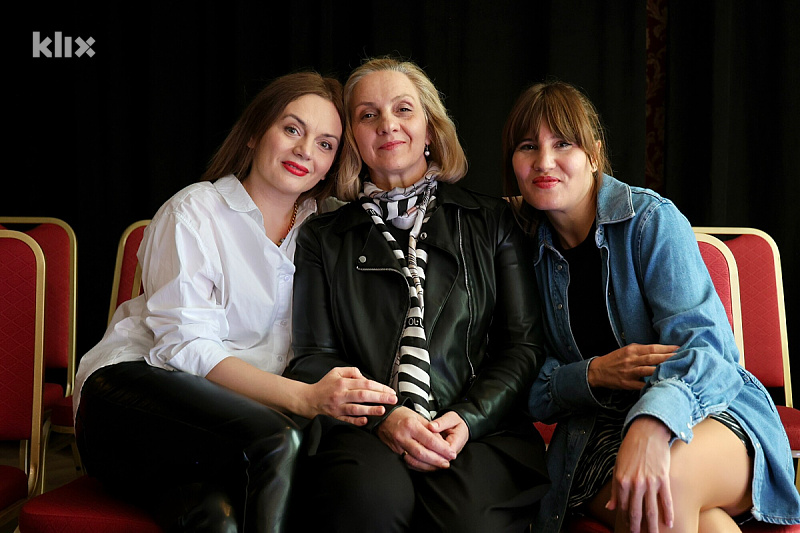
Director Nina Nikolić stated that this is an autobiographical story about the mother of Bosnian-Herzegovinian Dženana Džanić, who was a refugee in Germany. "Essentially, it is Džana's story that she wanted to present, to tell people, and to convey how important solidarity is when one is far from home," she said. Actress Dženana Džanić mentioned that this is partially her personal story. "'The Last Piano Lesson' is inspired by events from my mother's life. It is the period immediately after the war when we were refugees in Germany. The universality of this piece lies in its message of solidarity," she noted, among other things. She added that this story, unfortunately, remains relevant both in Europe and worldwide. She pointed out that this play offers an answer to how European countries should treat these people. The lead actress of the Sarajevo War Theatre Drama, Selma Alispahić, said that this is primarily a story about friendship, humanity, and kindness. "Here, two women from seemingly two different worlds meet—a German and a Bosnian. I play the German, Frau Gut, who is a piano teacher and tries to ease the refugee days for Jasmina, the Bosnian, by giving free piano lessons to her daughter. She is one of those women we have all probably encountered at some point in our lives, whether we had a refugee experience or not, whether we simply traveled the world and met people who were kind to us and interested in what we had to say. They were interested in our story," she said. She added that Frau Gut is one of the good women from the West who did not want to turn a blind eye to what was happening in Bosnia and Herzegovina in the 1990s. "This is a story set after the war, in which she continues to try to understand these conflicts, to help people, and individually, as much as she can, to make life easier for those in trouble," she explained. The author of the play "The Last Piano Lesson," Adnan Lugonić, noted that some of the most interesting stories in our literature originated within families, which were later written down, turned into plays, and so on. "This play also originated from one such story. My wife's mother told it for a long time. You listen to these stories and don't always react to them, to have the reflex that it could become something more than just an ordinary story you hear," he said. The idea for the play arose as a reaction to current events in the world and how Europe treats refugees. "That story 'rang a bell' for me that it should be told, that it should not remain within the family circle but that it now has broader social importance," he said, among other things. The dramaturge is Adnan Lugonić, the set and costume designer is Adisa Vatreš Selimović, the composer is Oliver Josifovski, the photographer is Velija Hasanbegović, while the poster design is by Almir Kurt Kugla. Repeat performances are scheduled for April 18 and 19, starting at 8 PM. Tickets can be purchased exclusively online via the platform karter.ba.
Society
At the premiere of the play "The Last Hour of the Piano" at Theater071: A story about the importance of solidarity with refugees
The performance of the text "Posljednji čas klavira" by Adnan Lugonić, directed by Nina Nikolić, will be held on April 17 starting at 8 PM at Teatar071 in Sarajevo, located at Sime Milutinovića 2/II. Ahead of the premiere, the show's team held a gathering with media representatives.
ingestion