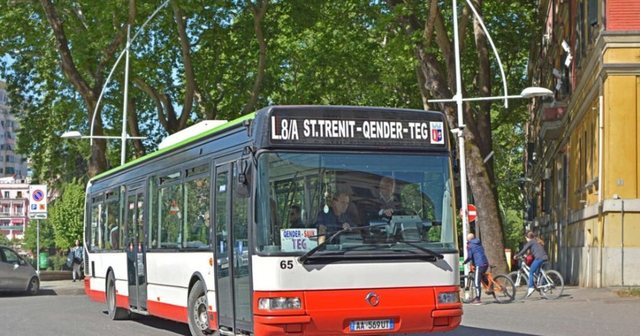
Compensation of 100 lek per liter for a 6-month period. This is the main request that public transport operators have sought approval for, through an "Emergency Anti-Crisis Package" submitted to the ministries on April 1, to avoid reducing service at the national level by up to 30%.
Regarding the measure to compensate fuel prices, Kostandin Foni, chairman of the National Association of Urban Transport, told "Monitor" that the scheme is feasible, as it is proposed to be similar to 2022.
It is proposed that the compensation be carried out for a 6-month period, and the fund is calculated at a value of 300 million lek or about 3 million euros. He also guarantees that, in addition to the available documentation from operators for fuel purchases and expenses, consumption is calculated, as it has not changed from the 2022 period.
"The scheme is entirely feasible, as it is requested to apply a direct financial compensation mechanism, based on actual fuel supply invoices, tax declarations, and the verified consumption level according to licensed activity, which has not changed from 2022 consumption. It is also a previously proven scheme during a crisis period that has worked and reduced operators' costs.
If in 2022 the state budget made available a fund worth 500 million lek, of which 60% or about 300 million euros was used for the 6-month compensation. The calculated expenses remain the same. So, for this crisis as well, a fund of 3 million euros is needed available to operators," said Mr. Foni.
In addition to compensation, as a main measure to reduce costs and avoid service reduction, transport associations also request a review of the fiscal burden.
Including the removal of the circulation tax and excise duty on fuel purchased by the sector, as well as reducing VAT from 20% to 5%.
After two consecutive letters and a meeting held, the two main transport associations—the National Association of Urban and Interurban Transport and the National Association of Urban Transport—have submitted to the Ministry of Economy and Innovation and the Ministry of Infrastructure and Energy the approval of the package with 4 fiscal measures.
Regarding the submitted requests, operators are expected to receive a response on Tuesday, where it has been announced that a meeting will be held between them and the ministers.
Public Transport Anti-Crisis Package Submitted to Ministers Ibrahimaj and Karakaçi
Under the conditions of a significant and continuous increase in fuel prices, which has created a deep imbalance between real operating costs and unchanged sector revenues, we present for discussion these priority requests, supported by legal precedents and the need to guarantee an essential public service:
1. Approval of an emergency anti-crisis package, in accordance with existing precedents
Immediate intervention is required through a financial support package, taking as a legal and practical basis VKM no. 225, dated 13.04.2022 "On determining the procedures, documentation, and compensation measure for urban, suburban, and interurban transport line companies, part of the anti-crisis package," which was approved under similar crisis conditions to compensate public transport operators' fuel costs by 100 lek/liter.
This decision, supported by Article 100 of the Constitution and budget legislation (the state budget law), has sanctioned the principle of state intervention in extraordinary situations to guarantee the continuity of a vital public service.
From the general data, it appears that the financial package of that period was worth about 500 million lek, of which about 55–60% of the fund was used for a period of about 6 months.
This precedent clearly proves that intervention is possible and legally justified, the financial effect is manageable for the state budget, and the compensation mechanism is feasible and verifiable through tax documentation and administrative control. Under these conditions, the reactivation of a similar scheme, adapted to the current price level and real sector costs, is required.
2. Immediate review of the fiscal burden, removal of the circulation tax
Since the circulation tax constitutes an important component in the fuel price structure, its suspension or temporary exemption for public transport operators is required.
This tax is defined in Law no. 9975, dated 28.07.2008 "On national taxes," as amended, at the level of 27 lek/liter, together with the carbon tax of 3 lek/liter, and is applied uniformly on gasoline and diesel.
Being a fixed burden included in the final price, it weighs proportionally more under conditions of market price increases. In the function of public interest and considering the special nature of public transport as a social service, suspending this tax for this sector constitutes a justified measure supported by the principle of fiscal proportionality.
3. Removal or suspension of excise duty on fuel for this sector
Excise duty on fuel, also defined within Law no. 9975/2008 and relevant fiscal legislation, is applied at the level of about 39.4 lek/liter for diesel and constitutes one of the main components of the final price.
As an indirect tax with a direct effect on operating costs, it weighs heavily on public transport operators, who cannot transfer this cost to consumers due to regulated tariffs.
Under these conditions, continuing to apply the excise duty at the same level creates a visible disproportion between the fiscal burden and the economic capacity of the sector, undermining the principle of fairness and proportionality in taxation. Albanian legislation itself provides exemptions for certain sectors (such as fishing), which strengthens the argument for differentiated treatment for public transport as well.
VAT, regulated by Law no. 92/2014 "On value-added tax," is applied at the standard rate of 20%, directly increasing the final price and limiting access to this essential service.
Since public transport fulfills a social and economic function, and considering the practices of countries in the region where this rate varies from 0% to 5%, complete removal or reduction of VAT is required.
If the above fiscal measures are not feasible immediately, it is requested that a direct financial compensation mechanism be applied, based on actual fuel supply invoices, tax declarations, and the verified consumption level according to licensed activity.
This mechanism, provided and previously proven by VKM no. 225/2022, guarantees transparency, administrative control, and fair distribution of public funds, avoiding abuses and directly targeting the real need of the sector.
These requests do not constitute a privilege for the sector, but a necessity to guarantee the continuity of an essential public service, in accordance with constitutional principles of proportionality, equality in taxation, and protection of public interest.
Non-intervention at this stage would lead to direct consequences for citizens, through service reduction and increased social costs, making intervention not only justified but mandatory for economic and social stability. /Monitor