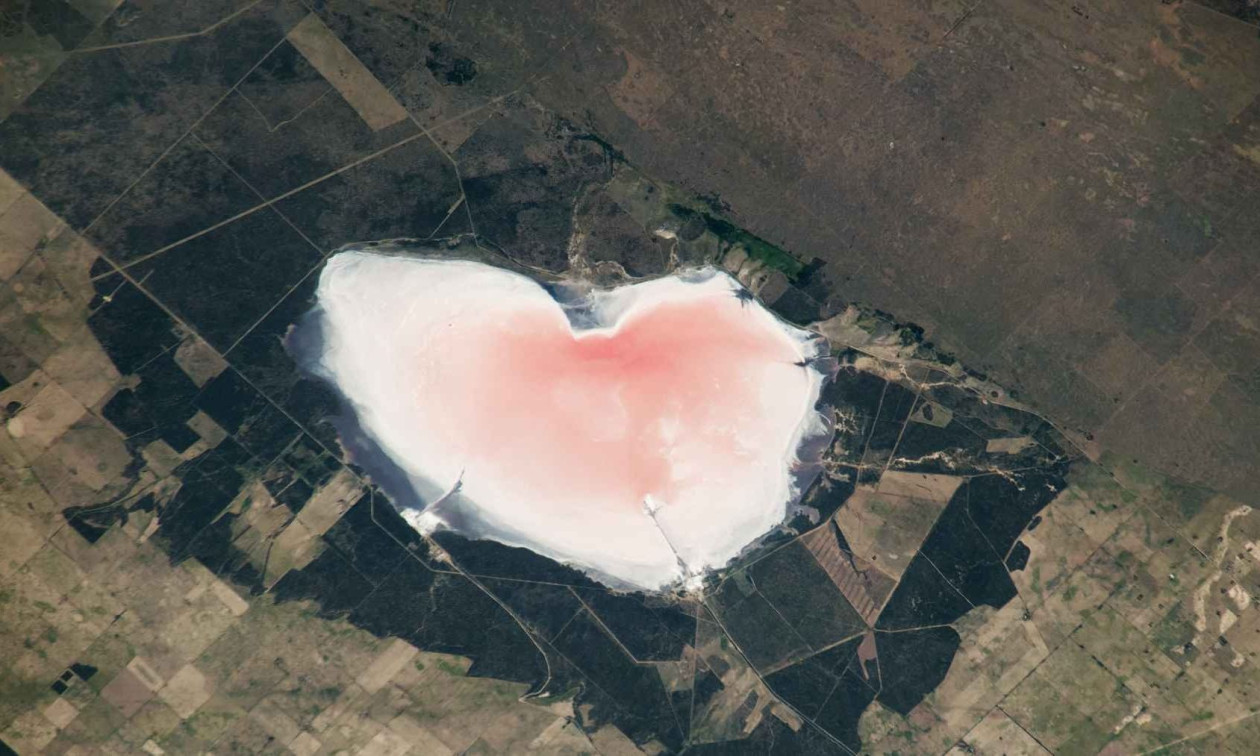
NASA has released a special Valentine's Day image from space, showing a natural formation in Argentina that resembles a large pink heart. The photo, taken by an astronaut aboard the International Space Station, captures Salinas Las Barrancas, a salt lake in Buenos Aires Province, which from orbit looks like a "caramel heart" nestled among agricultural fields.
The lake, about 10 kilometers wide and located roughly 53 km from the city of Bahía Blanca, forms in a low valley that fills with water during rainfall and later dries up, leaving behind white salt layers. Its pink color comes from microorganisms that thrive in highly saline conditions, such as Dunaliella salina algae, which produce reddish and pink pigments. As salinity increases, these organisms and specialized bacteria further intensify the distinctive hue.
The lake is very shallow and constantly changes appearance based on rainfall and temperatures. After rains, the water dilutes the color, while during dry periods the salt concentrates and the pink becomes stronger and more visible. The area is not only a natural phenomenon but also an important economic zone where salt is extracted for various industries. At the same time, the ecosystem supports life adapted to high salinity, including birds like flamingos, which derive their color from pigments in their diet. NASA emphasizes that such images help scientists monitor environmental changes and the impact of climate on fragile ecosystems, showing that even the most beautiful landscapes are in constant flux.
In this way, Argentina's "pink heart" from space becomes not only a symbolic sight for Valentine's Day but also a reminder of the connection between climate, life, and the environment.