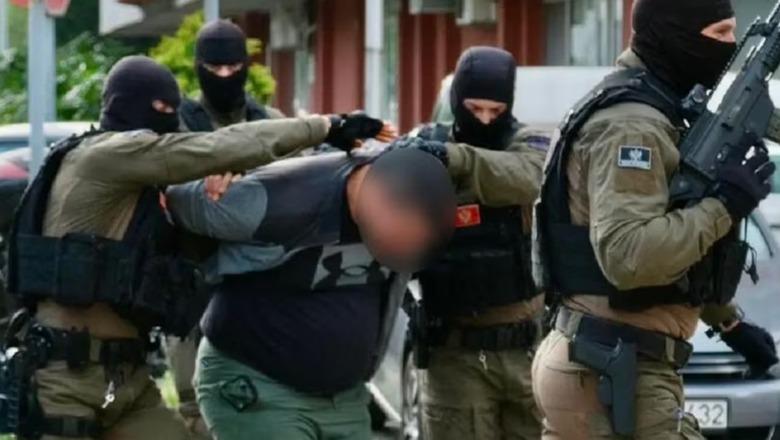
Twelve arrests, operations in several countries, activities across five continents, and the seizure of 4.2 tons of drugs. This is the epilogue of an international police action, carried out in Montenegro and Germany.
Among those arrested in Montenegro is S.F., whom the country's police revealed is one of the leaders of a Balkan cartel. Montenegrin media identified him as Svetislav Filipović, suspected of the illegal production, possession, and distribution of narcotics.
He faces up to 15 years in prison and is also accused of illegal trafficking of weapons and explosive materials.
There is not much information about him, but during the release of details about the operation, the European police agency, Europol, stated that a high-risk individual had been arrested in Montenegro.
He is from Podgorica and is 47 years old, and since 2002, he has been listed as the director of the company "Spectacular," according to the public business data registry "Company Wall."
So far, this company has received 139 shipments from 16 countries, including Ecuador, Ukraine, and Colombia, according to data from the Volza platform, which collects information on global trade.
According to the platform, the company has imported bananas, watermelons, dried fruits, and nuts, with one of its suppliers being a company from Hong Kong.
In 2023, "Spectacular" generated total revenue of 664,206 euros.
Filipović is also one of the co-owners of the company "Europayment."
The accounts of both companies have been blocked.
In addition to the arrests in Montenegro, four individuals were also arrested in Germany, though there is still limited information about them.
According to the international police organization, Interpol, several global organized crime groups operate in Germany, engaging in a wide range of crimes, such as drug trafficking, property crimes, and human smuggling.
"Deeply rooted" in cocaine trafficking routes
Those arrested on April 15 are accused of multi-ton shipments of cocaine from South America to European Union countries, said the director of Montenegro's Police Directorate, Lazar Šćepanović.
According to him, this criminal group secured and facilitated the sale of cocaine and cannabis, both in Montenegro and in other countries, such as Germany, the Netherlands, Belgium, Bolivia, and Thailand.
This operation confirms that, despite the blows dealt by previous operations, Balkan groups have not disappeared but continue their activities, adapting and rebuilding their logistical chains, says Saša Đorđević from the Global Initiative Against Transnational Organized Crime.
"Balkan criminal groups remain deeply rooted in traditional cocaine trafficking routes, particularly along the Latin America-Europe line, with Germany still being one of the main markets," says Đorđević.
Organized crime groups from the Western Balkans have been identified by international organizations, such as Europol and Interpol, as key players in smuggling cocaine from Latin American countries—such as Brazil, Colombia, and Ecuador—primarily to Western European markets.
However, besides cocaine, cannabis was also smuggled—approximately 1.5 tons were found in 12 different seizures.
Cannabis, as Europol stated, was smuggled into the European Union from and through Albania, Thailand, and the United States.
The presence of cannabis, explains Đorđević, shows that Balkan criminal groups are not specialized solely in cocaine.
"They are now operating opportunistically and entering other markets, where they offer a secure channel and good profits," he adds.
Around 100 police officers participated in the recent operation, and besides German and Montenegrin institutions, support was also provided by Austria, Spain, and Europol.
Following the arrests in Montenegro and Germany, the Office of the Supreme State Prosecutor in Podgorica filed an indictment against ten individuals.
The criminal charges accuse the suspects of repeated sale, transportation, and facilitation of narcotic drugs—cocaine and cannabis—while a group of four suspects is also charged with the criminal offense of organizing a criminal group.
"One suspect ordered and organized the maritime or air transport of large quantities of narcotic drugs—cocaine, cannabis, and hashish—to Podgorica, Germany, Bolivia, Thailand, Belgium, and the Dominican Republic," stated the Prosecutor's Office.
Europol also said that the group used air trafficking in addition to maritime routes.
Đorđević says this shows that these networks are continuously adapting their methods and seeking new smuggling channels.
"The use of air trafficking, including couriers and general aviation, has long been a concern, but its scale is still not fully clear," says Đorđević.
Besides new transportation methods, groups are also changing their routes.
Thus, a study by the Global Initiative Against Transnational Organized Crime last year showed that organized crime groups, whose members originate from Western Balkan countries, are using a new route to smuggle cocaine from Latin America to Europe via West African countries.
Montenegro is home to two criminal clans, Kavač and Škaljari, which have been in conflict since 2014, when several hundred kilograms of cocaine disappeared in Valencia.
More than 70 people have been killed in their conflicts so far. Last year, the country ranked tenth in Europe in the Global Organized Crime Index.
Besides Montenegro, Serbia and Bosnia and Herzegovina are also among the top ten. The Global Organized Crime Index assesses the level of crime and resilience to organized crime in 193 countries worldwide.