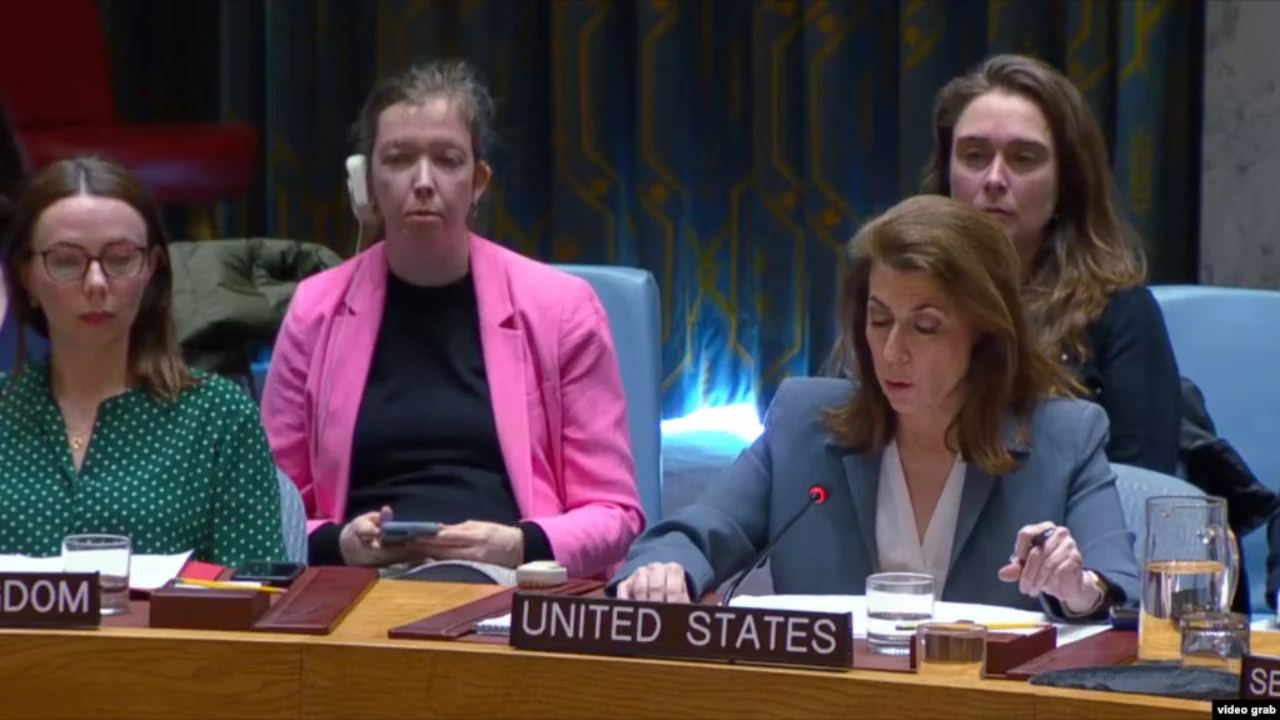
As in the past, Kosovo and Serbia exchanged accusations at the latest United Nations Security Council meeting on Kosovo, held Thursday in New York, while the United States has been clear in its stance that normalization of relations is the only way forward for the two countries.
"President [American, Donald] Trump and Americans are listening carefully for you to clearly commit to working and prospering together. We hope both sides will lower tensions and come to the table. We will work closely with leaders who look to the future, not the past. With real dialogue, not theater," said U.S. Deputy Representative to the UN, Tammy Bruce, reiterating that the U.S. remains committed to supporting stability in Kosovo and Serbia, in order to preserve stability in the Balkan region.
"The people of Kosovo and the people of Serbia are our friends. They deserve a future defined by security, economic opportunities, and neighborly relations, not by political tensions or recycled problems," she said among other things.
Kosovo's team stated that it does not expect normalization of relations with Serbia without clear accountability for the attacks in Banjska and Iber-Lepenc and guarantees to stop aggression, while Serbia's team accused the government of Kosovo's Prime Minister, Albin Kurti, of suppressing the voice of local Serbs.
Kosovo accuses Serbia of carrying out both attacks, but Belgrade denies everything. In the Banjska attack, a Kosovo Police officer was killed, while in Iber-Lepenc there was an explosion of explosive materials that resulted in damage to critical water and electricity supply infrastructure.
Kosovo's stance Kosovo's Minister for Foreign Affairs and Diaspora, Glauk Konjufca, said at the meeting that Kosovo continues to guarantee stability through its own democratic institutions, although, according to him, Belgrade continues to play its destructive role, mentioning Belgrade's attempts to interfere in Kosovo's elections to support the Serbian List, so as to reflect "its regime through a party in power."
The Serbian List is the largest party of Serbs in Kosovo and in the latest parliamentary elections on December 28 secured nine seats in the Kosovo Assembly. The Constitution guarantees this community 10 seats in the legislative institution.
"We call on Serbia to face its own reality and recognize Kosovo as an independent and sovereign state, not holding the entire region hostage to such hegemony," said Konjufca.
"Serbia and other malicious actors continue to turn minority rights into weapons and exploit Kosovo's multi-ethnic nature to promote division, disruption, undermining both our institutions and peaceful coexistence," he said. Serbia's stance Serbia was represented by Serbian Foreign Minister Marko Gjuriq, who began his speech by saying that Serbia "is not part of the problem, but part of the solution."
Later, Gjuriq said at the meeting that he speaks "on behalf of those under pressure in Kosovo," and claimed that for local Serbs in Kosovo, identity has become a source of insecurity, as "under the regime" of Kosovo's Prime Minister, Albin Kurti, Serbs are identified as "the others" and that arrests, arbitrary attacks, and "the exodus of Serbs," cannot be ignored. He did not support his claims with anything concrete.
According to Gjuriq, the Law on Foreigners has caused great concern for Serbs in Kosovo.
"There was a real risk that people who have worked for decades would be treated as foreigners, losing their right to stay or live in their homes. Their measures are not only legally unclear but show a continuity of reforming the situation. Serbs face numerous administrative and legal obstacles that make their lives more difficult, from access to public services to exercising fundamental rights."
On March 14, the Kosovo Government agreed to offer temporary residence permits and recognize identification documents for members of the Serbian community who are not equipped with Kosovo documents, as provided by the Law on Foreigners and Vehicles.
The decision was welcomed by the international community and by Serbia. Among other things, the Serbian minister requested the establishment of the Association of Municipalities with a Serbian majority because, according to him, Serbs "have been left without the legal framework promised to them."
However, he said in part of his speech that Serbs are ready to extend the hand of cooperation, as the two peoples "are not destined to remain in conflict."
"There is space, especially in economic cooperation, to build trust and create a common future, where the region approaches the European Union, becomes part of the common market, and exploits development opportunities."
Under the mediation of the European Union, Kosovo and Serbia have been dialoguing for normalization of relations since 2011, but not all agreements reached have been implemented.
The head of the United Nations Mission in Kosovo (UNMIK) Peter Nicolaisen Due mentioned a series of processes that have drawn attention in Kosovo in recent months, starting from the constitution of the Assembly, the formation of the Government, and the issue of the president, calling for the latter to have a quick epilogue and to avoid new elections. He said he hopes that Kosovo's Prime Minister, Albin Kurti, and Serbian President, Aleksandar Vučić, will meet in the near future in Brussels.
Both the United States and Kosovo have insisted that the work of the UNMIK mission in Kosovo has ended, while Serbia has insisted on the continuation of its work.
The UNMIK mission operates under United Nations Resolution 1244, which was a compromise between Western countries and Russia to end the conflict in Kosovo.
This mission is neutral regarding Kosovo's status, and after the country's declaration of independence in February 2008, UNMIK has transferred all competencies to local institutions.