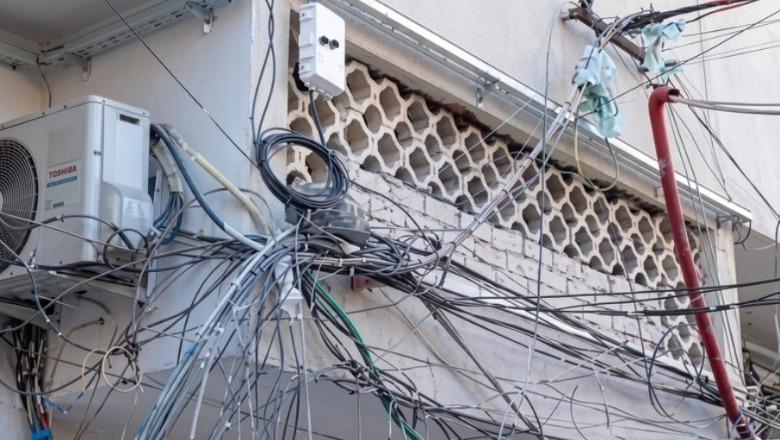
In Albania, the practice of installing internet cables in the air and on building facades, which together with electrical cables create the image of 'spider webs' across cities, will come to an end.
According to the proposed draft, all new constructions in Albania, as well as buildings undergoing deep reconstruction, will have a new legal obligation: 'mandatory installation of internal infrastructure for fiber optics.'
This is just one of the novelties of the new draft law "Gigabit Infrastructure Act," which has just been opened for public consultation by the Ministry of Infrastructure and Energy.
This draft, expected to replace the 2016 law, aims to align Albanian legislation with the new European Union Regulation (2024/1309), paving the way for a true digital revolution and 5G networks.
End of "Monopolies" in Residential Buildings
One of the biggest hurdles for citizens and telecommunications operators has been access within apartment buildings. Often, builders or building administrators created obstacles or monopolized the entry of certain operators.
The new draft law puts an end to this practice. According to Chapter VIII of the draft, an obligation is created that within two years of the law's approval, every new building must have a dedicated "Access Point" for Very High Capacity Networks (VHCN). Furthermore, the placement of a voluntary "Fiber-ready" label is foreseen for buildings that meet these technical standards, an element that could also increase the property's value in the market.
"Every entrepreneur has the right to build, at their own expense, their network up to the access point in the building's physical infrastructure," emphasized the report signed by the Minister of Infrastructure and Energy, Enea Karakaçi, thus guaranteeing free competition and choice for the citizen.
Reduction of Costs and the "Single Information Point"
Laying fiber optics today requires time, high costs for excavations, and heavy bureaucracy for construction permits. The "Gigabit Infrastructure Act" obliges public and private operators (including those for roads, water supply, or energy) to share their physical infrastructure with telecommunications companies.
If a road is being opened to lay water pipelines, the parties must coordinate so that fiber optic cables also pass through the same channel. This will not only significantly reduce financial costs for companies—costs that ultimately translate into cheaper internet tariffs—but will also avoid the phenomenon of opening and closing the same road multiple times.
To manage this, the Electronic and Postal Communications Authority (AKEP) will establish a "Centralized Information System." Here, every operator can see existing networks and planned public works, eliminating unreasonable requests and bureaucratic delays.
This law is not just a need of the domestic market but a non-negotiable obligation within the framework of EU membership (Chapter 10: "Information Society and Media"). The government has committed through the "National Reform Agenda 2024–2027" to create a secure and accessible digital society.
The draft is currently open for 20 working days for comments and recommendations from interest groups. If approved as proposed, it will mark the end of the era of chaotic cables across cities and the beginning of an era where gigabit internet is treated as a basic essential service, just like water and electricity.