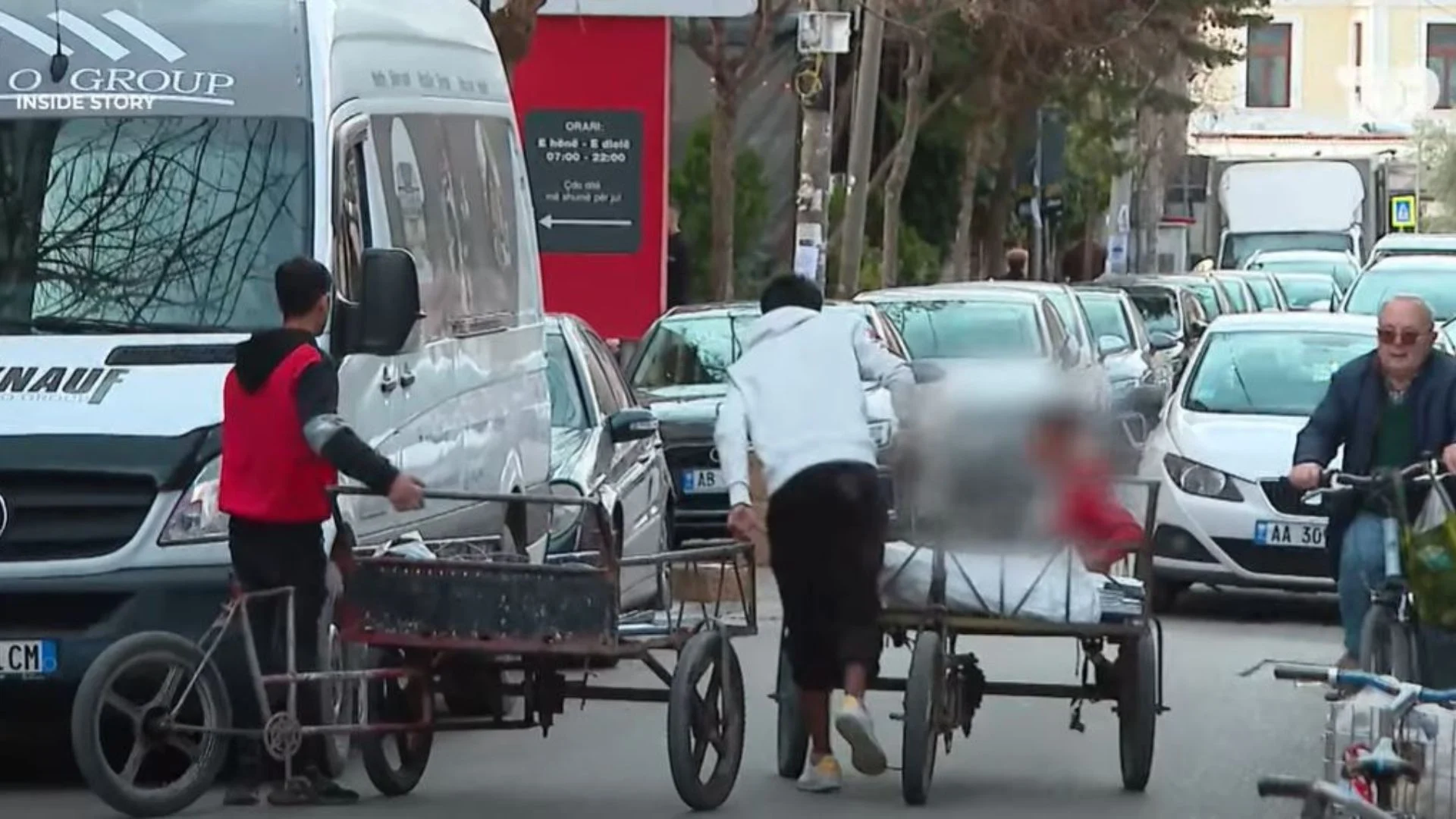
Such scenes are commonplace in Tirana and beyond. These little ones have lost their childhood. Often, the determining factor is the very role of the parents, not to mention the prejudice and discrimination that leave the Roma community outside of social integration.
"For me, it has been a challenging, difficult journey. I have faced social exclusion since childhood, a kind of exclusion, from school, from society, to some extent. Ethnic differences were noticeable; at our age, they were seen based on skin color," expressed Franko Velia, General Secretary of Roma Versitas Albania.
"The factor of prejudice, discrimination, is one of the essentials, but not the only one," stated Altin Hazizaj, Director of the Center for the Protection of Children's Rights.
Prosecutor Alma Bramo, who led the investigations in Tirana that led to the handcuffing of 8 individuals, parents who exploited children for begging, reveals the biggest social wound that was opened for these minors.
"Almost all the children we interviewed had either never started school, or at an age when they should have finished, they were in first grade, and two children who were in school, one did not know how to write and read, and the other was at risk of dropping out because returning home at 6 a.m., you cannot be ready to start activities at 8 a.m.," said Alma Bramo, prosecutor.
"The phenomenon of segregation is very present; even in schools, there is segregation. The school content is homogeneous, and social interaction is lacking, and there is a lack of positive examples. We have followed cases that are under judgment, segregated schools, all with Roma contingents," expressed Franko Velia, General Secretary of Roma Versitas Albania.
It seems a vicious cycle has been created that builds generations, but not the street lifestyle for children. These little ones who are forced today to beg, abandoning school, in adulthood will be illiterate, not knowing how to read or write.
"There are also stigmatizations that say it is culturally inherited, and Roma children must beg because they inherit it generation after generation. Begging is not inherited generation after generation, but poverty certainly is, social exclusion, certainly is," expressed Franko Velia, General Secretary of Roma Versitas Albania.
"All the families that were identified were families with mothers, fathers, and had housing. The woman of the house and the child had to provide income. The fathers did not work; they simply did transportation, bought flowers," said Alma Bramo, prosecutor.
This is the main reflection of Roma families, who unfortunately have not managed to integrate properly. And if we talk about school abandonment, this also comes due to another very important factor, which is extreme poverty. The Roma and Egyptian communities, to a considerable extent, still live in unstable housing and outside any conditions, whether of physical well-being or hygienic-sanitary.
"Where do Roma children live, have you seen? The majority of Roma children live in covered plastic bags. Is that a life? The state has a duty to guarantee housing for every citizen, and that is where discrimination begins. The moment you have guaranteed housing, the moment you have guaranteed employment, integration, professional training. The moment you have taken measures and the parent exploits the children, here the relationship is interrupted, and the parent abuses the child and is held accountable before the law," expressed Altin Hazizaj, Director of the Center for the Protection of Children's Rights.
"We cannot talk about quality education when a child lacks the basic needs to pursue education. They go from first grade to fifth grade because economic conditions are difficult; they must be contributors in the economic aspect, since parents are not in working conditions and are involved in the informal sector. Recyclable waste, housing conditions are utterly scandalous. There are communities living in shacks and tents, in unstable housing," expressed Franko Velia, General Secretary of Roma Versitas Albania.