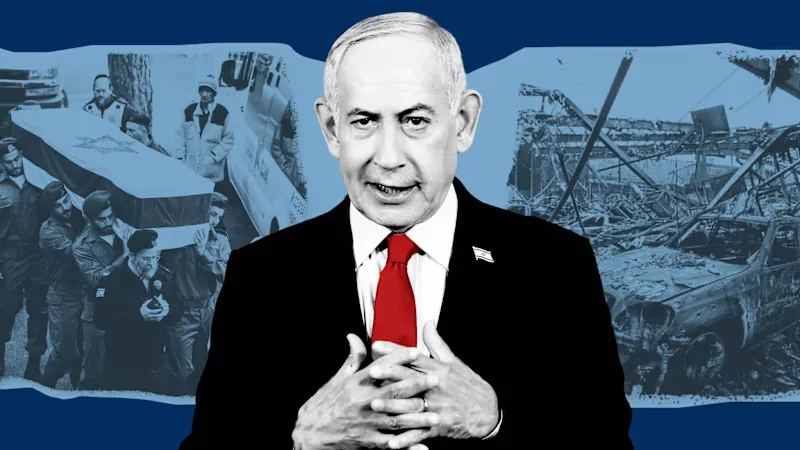
Following Hamas's attack on October 7, 2023, Benjamin Netanyahu promised a "total victory" in the ensuing conflict. But more than two years later, Israel's enemies, though weakened, continue to hold out. Hamas and its militants still control half of Gaza. Hezbollah, which Netanyahu claimed was "destroyed" in 2024, continues to launch rockets from Lebanon toward northern Israel. And less than a year after declaring a "historic victory" over Iran, Israel and the U.S. are once again at war with the Islamic Republic. "There is no longer any containment of threats," Netanyahu said in a speech to newly commissioned army officers. "Nor the idea of a 'villa in the jungle,' where you hide from predators behind a wall. On the contrary, if you don't go into the jungle, the jungle comes to you." In this vision, which some analysts call a "Netanyahu doctrine in the making," Israel must launch "preemptive" wars against any perceived threat; expand territory from neighbors to create "buffer zones" between enemies and citizens; and maintain constant force as the sole guarantor of security. Michael Milshtein, a former military intelligence officer and now a professor at Tel Aviv University, considers this approach a "post-traumatic national doctrine," formed instinctively after the October 7 attack but without deep strategic study. Critics highlight the lack of diplomatic initiatives that could bring a sustainable regional solution and warn of the risk to Israel's international reputation from igniting one conflict after another, regardless of the human cost to the other side. According to Milshtein, the stance of Netanyahu and his supporters can be summarized: We do not trust the Arabs and believe only in force and land. Multiple conflicts, with no visible end The recent U.S. and Israeli war against Iran has escalated tensions in the Middle East and caused shocks to the global economy. However, the use of force against potential threats is not new for Israeli prime ministers: Menachem Begin bombed the Iraqi nuclear reactor in 1981, while Ehud Olmert did the same against the Syrian reactor in 2007. Although Netanyahu is known for his hardline stance toward Iran and the Palestinians and has the reputation of "Mr. Security," during his three decades in power he was considered more cautious about open conflict. This changed after Hamas's October 7 attack, the deadliest day for Jews since the Holocaust. Dennis Ross, a former senior American diplomat and a Netanyahu observer since 1989, says "caution seems to have vanished." "Every Israeli prime minister has learned that you cannot buy 'quiet,' you must initiate rounds of fighting to prevent threats," said a former Israeli official. Unlike previous wars, the current conflicts have no visible end. While David Ben-Gurion built the national security doctrine on short, decisive campaigns, Israel has been fighting for two and a half years, its longest war in history. The Israel Defense Forces (IDF) are waging an air war against Iran, expanding a ground offensive in Lebanon, and still holding half of Gaza, as well as parts of southwestern Syria. Additional forces are deployed in the occupied West Bank, while Houthi rebels in Yemen have resumed missile attacks. Netanyahu and his ministers aim to create a "broad security zone" in southern Lebanon and maintain buffer zones in Gaza and Syria, a plan analysts and former officials consider "unsustainable" due to current military capabilities. The IDF has warned that it needs about 15,000 additional troops, half of them ground forces, to keep the situation under control. The war against Iran has high support, with 78% of Israeli Jews favoring its continuation according to a poll by the Israel Democracy Institute. But some political opponents see the permanent state of war as a political tool for the prime minister, especially ahead of upcoming elections. The lack of concrete results has caused public anger, especially when compared to Netanyahu's promises to destroy Hezbollah and Hamas, or the declared victories against Iran. Many residents of northern Israel are calling for harsher actions in Lebanon to stop Hezbollah's rockets. Despite criticism, Netanyahu and his supporters insist the military strategy is going according to plan, declaring that the recent wars "have changed the face of the Middle East" and have guaranteed Israel's existence. Analysts point out that the inability to translate the IDF's operational achievements into a strategic victory or a sustainable diplomatic solution is Netanyahu's main failure. "Doctrine? That's too soft a term," says a former official. "Where there's a problem, he sends the army, regardless of long-term consequences." Another potential problem is the risk to strategic relations with the U.S., where public opinion and support for Israel had already fallen even before the start of the new war against Iran. However, Netanyahu appears determined. He believes that if he fights long enough, Iran will be militarily destroyed, toppled, or forced to negotiate surrender. "They will either surrender or be left with sticks and stones," says a regional official.
Society
One battle after another... Netanyahu's new security doctrine.
Following Hamas's attack on October 7, 2023, Benjamin Netanyahu promised a "total victory" in the ensuing conflict. But more than two years later, Israel's enemies, though weakened, continue to hold out. Hamas and its mi
ingestionalbania