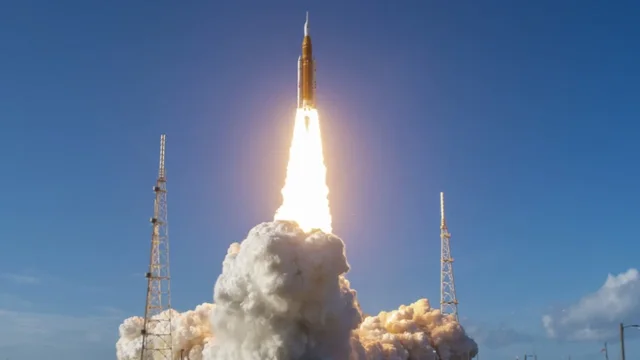
NASA's Artemis II mission has officially launched toward lunar orbit. The Space Launch System rocket lifted off from Pad 39B at Kennedy Space Center in Florida on April 2, sending the Orion spacecraft toward the Moon's orbit. Prior to launch, the technical team faced several minor issues. Specialists had to repair the safety system that enables rocket destruction in case of trajectory deviation. This system was crucial for the launch and was successfully tested. Shortly after, an issue with the battery sensor and the Launch Abort System communication equipment was also resolved. Although Artemis II will not land astronauts on the Moon, it plays a key role: the first crewed test of all Orion spacecraft systems, including navigation, communication, and life support, ensuring the technologies that will enable humans to return to the Moon in future missions. The crew consists of American commander Reid Wiseman (50 years old), American pilot Victor Glover (49 years old), American specialist Christina Koch (47 years old), and Canadian astronaut Jeremy Hansen (50 years old). This mission will set several historic records: Hansen will become the first Canadian to orbit the Moon, Glover the first African-American, and Koch the first woman to see the far side of the Moon. During the nine-day journey, the crew will travel over 400,000 kilometers from Earth, surpassing a distance from our planet that no one has ever reached before, and more than 7,600 kilometers away from the Moon. This is another major step toward humanity's return to the Moon, paving the way for future explorations and new space challenges.
Society
Historic moment/ Artemis II mission officially begins, humanity approaches the Moon again after 53 years.
NASA's Artemis II mission has officially launched toward lunar orbit. The Space Launch System rocket lifted off from Pad 39B at Kennedy Space Center in Florida on April 2, sending the Orion spacecraft toward the Moon's o
ingestionalbania