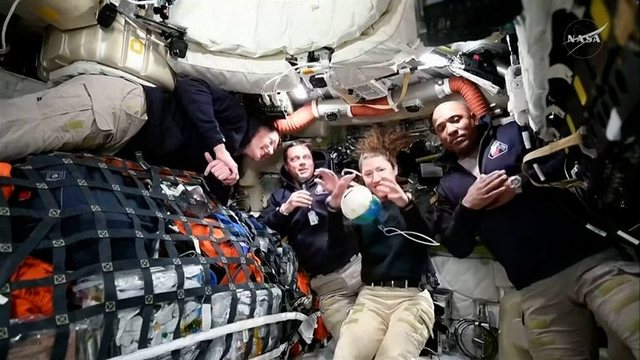
NASA astronauts part of the Artemis II mission have experienced rare emotions during the historic flight around the Moon, bringing new and unprecedented views from its surface.
During the journey aboard the Orion capsule, the crew photographed the Moon's craters and rock structures, while from the windows they also observed spectacular phenomena such as Earthrise over the lunar horizon and a solar eclipse. One of the most interesting discoveries was the observation of the Orientale region, a giant formation about 950 kilometers in diameter, which until now had not been directly seen by humans.
The astronauts also reported unusual colors on the lunar surface, including shades of brown, green, and orange, challenging the traditional perception of a purely gray landscape.
After completing the orbit around the far side of the Moon, the four astronauts have now begun their return journey to Earth. The most critical phase of the mission is expected during atmospheric re-entry, where the capsule will face extreme temperatures and speeds reaching up to 30,000 kilometers per hour. Orion's heat shield will be crucial for the crew's survival, as any defect could have fatal consequences.
Before landing, the crew module will separate from the rest of the spacecraft, while the parachute system will activate in several stages to ensure a controlled descent into the ocean, near the shores of San Diego.
The Artemis II mission represents humanity's return to lunar orbit after more than 50 years, paving the way for future missions aimed at establishing a sustainable human presence on the Moon and beyond, exploring Mars.