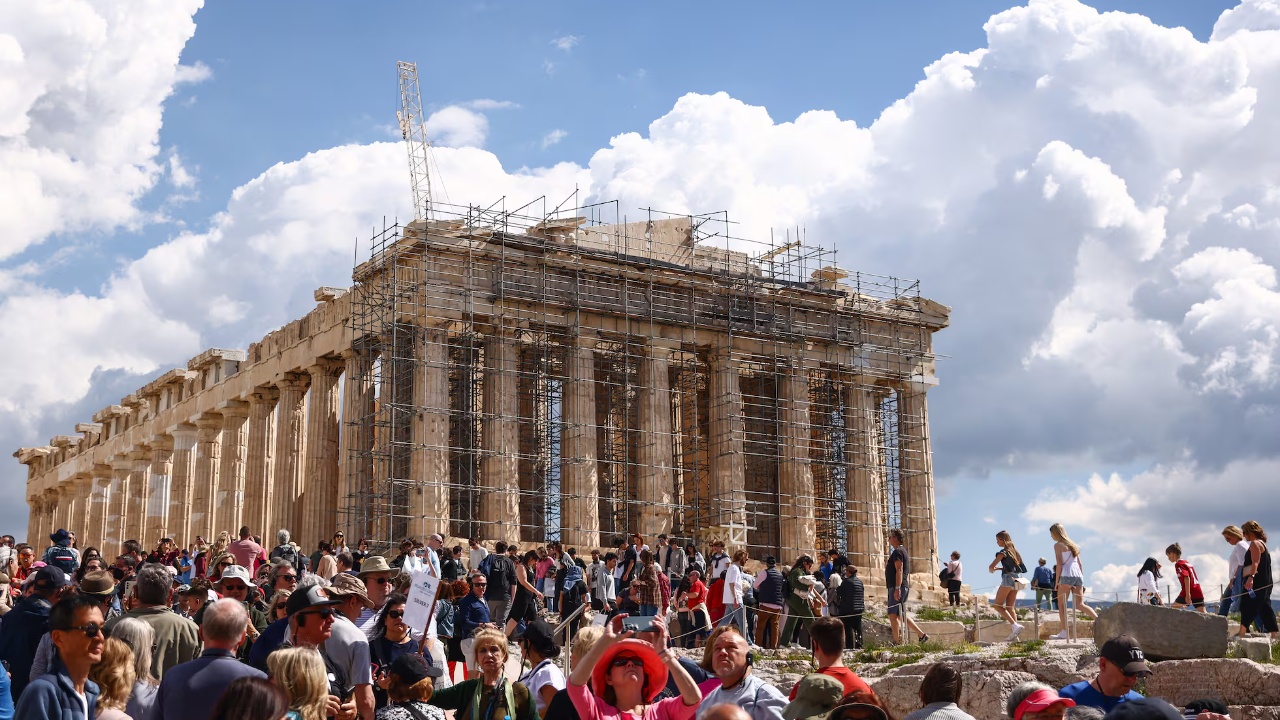
In the heart of ancient Athens, in narrow alleys and near archaeological monuments, groups of tourists are everywhere, following guides through the crowds. Such scenes would once have been welcomed by authorities, but today the situation is viewed differently.
For Mayor Haris Doukas, the start of the tourist season is pushing the historic center toward overcrowding, risking the loss of its character.
"Athens cannot function as a giant hotel," he said, emphasizing that rules and limits are needed for the city's development and that cities themselves must have a say in this process.
Last year, more than 8 million tourists visited Athens, a record for a city that not long ago was seen merely as a stopover on the way to the Greek islands. In the Plaka area, located below the Acropolis, stays in short-term rental apartments have more than doubled since 2018, according to a study commissioned by the municipality.
Authorities warn that the time to act is now, so that Athens does not fall victim to its own success. The signs are evident: a sharp rise in rents forcing residents to leave and an infrastructure facing overload.
"All of Athens is turning into a construction site to cope with the situation. When you have 700,000 residents and 8 million visitors, the pressure is immense," Doukas said, citing the construction of energy grids, water supply systems, sewage networks, and 5G technology.
Doukas took office in 2024 after winning the election with the support of the opposition Pasok party, promising to make the city greener. According to him, around 3,855 trees have been planted in the historic center during his term. But with the rise in tourism, he has also faced uncontrolled development in the most frequented areas.
The mayor has targeted construction companies seeking to build high-rise buildings near the Acropolis, as well as investors and entrepreneurs in the tourism sector. Rooftop bars and restaurants, often unlicensed, are also in focus. Recently, he has warned that he will use a draft law on tourist land use to seek a total ban on new activities in the historic center.
"We will stop every tourist investment in Plaka. There is no more room for short-term rental apartments, hotels, or other forms. The area is overcrowded. It's time to say enough," Doukas stated.
He has also floated the idea of freezing construction permits for new hotels, following government measures to limit short-term rentals in areas near the Acropolis. Recently, he has gained support from the hotel industry. The head of the hoteliers' association, Evgenios Vassilikos, has suggested setting a cap on hotel construction, citing Barcelona as an example, where no new permits have been issued since 2017.
"When the entire center of Athens is turning into a hotel zone, I cannot be the only one saying this," Doukas said, adding that the discussion has already officially begun and that Athens should not become another Barcelona.
He also mentioned the example of Barcelona's mayor, Jaume Collboni, who has announced a complete ban on short-term rentals by 2028, as part of efforts to make the city more livable. Athens and Barcelona are among 15 cities that have joined a European housing plan, calling on the European Union to take strong measures to address the crisis. According to Doukas, the biggest problem remains the lack of affordable housing for citizens.
"We have set up a social housing office to identify buildings and apartments that can be renovated with EU funds. We want to encourage young couples to stay in the center," he said.
He added that unlike cities filling up with concrete and skyscrapers, Athens aims to create more public spaces, including demolishing buildings to build parks and playgrounds.
"Athens is for its people. It is not just for those who want to exploit it," Doukas concluded.