From the ancient empires and the trade routes of Marco Polo to today's energy "artery" transporting 20% of global oil trade, how a narrow maritime passage between Iran and the Persian Gulf evolved into the world's most dangerous economic "pressure valve," and why the current turmoil could trigger energy shocks, risks to global food security, and market instability.
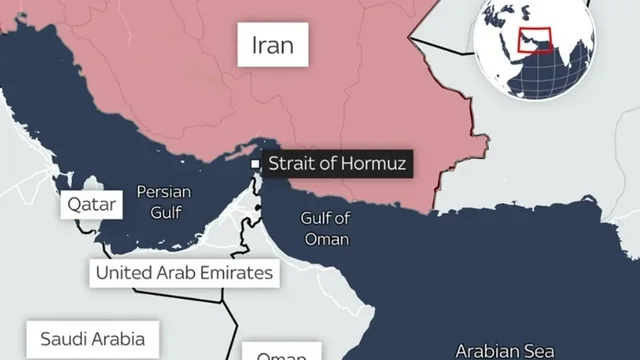
The Strait of Hormuz, a narrow sea passage connecting the Persian Gulf to the Gulf of Oman and the wider Indian Ocean, is once again at the center of international concern amid tensions related to the war in Iran.
What appears as a thin river strip on a map has been a crossroads of trade, empire, and geopolitics for thousands of years. Today, as maritime shipping tensions have rattled global markets, its historical role helps explain why developments along this passage have such wide-ranging consequences.
Located between Iran to the north and the Arabian Peninsula to the south, it is the only natural outlet from the Persian Gulf. At its narrowest point, it is about 30-35 km wide, while designated shipping lanes are even narrower. This geography makes it one of the most strategically sensitive "chokepoints" in the world, where control over a limited maritime space can influence global flows of energy, trade, and military power.
In modern times, the Strait of Hormuz has become almost synonymous with global energy security. Roughly one-fifth of the world's daily oil production passes through its waters, along with about 20% of liquefied natural gas (LNG). Tankers from major producers like Saudi Arabia, Qatar, and the United Arab Emirates must traverse this passage to reach international markets. Any tension, whether military escalation, attacks on vessels, or political decisions, can quickly impact the global economy, raising fuel prices and destabilizing supply chains.
Straits also play a less recognized but crucial role in global food security. Gulf states are major exporters of chemical fertilizers, such as urea and other nitrogen-based products essential for agriculture worldwide. And these shipments pass through this strait, meaning disruptions to maritime transport can affect not only energy markets but also agricultural production far beyond the region.
However, the strategic importance of the Strait of Hormuz dates back much earlier than oil, gas, and modern geopolitics. Its role as a connecting gateway between regions dates back thousands of years, to the earliest major cultural and trade exchanges of the Near East.
As early as the third millennium BCE, the Persian Gulf was a vital trade route connecting Mesopotamia, the Arabian Peninsula, Iran, and the Indus Valley Civilization. Traders from city-states like Ur and Lagash traveled these waters in search of copper and diorite from Oman, as well as wood, precious stones, and luxury goods from regions further east. Maritime trade along these routes helped sustain early urban economies and facilitated cultural exchange over vast distances.
Any ship traveling between Mesopotamia and the Indian Ocean had to pass through a narrow sea passage, waters that later became known as the Strait of Hormuz. Even in the Bronze Age, this made them a crucial corridor for trade, communication, and the spread of ideas.
As power in the Near East shifted from one empire to another, control over the Gulf and its entrance changed hands. Around 500 BCE, the Achaemenid Persian Empire, under rulers like Darius I, unified a vast territory from the Mediterranean to the Indus Valley. Under Persian rule, the Gulf became a lifeline artery of the empire, connecting distant provinces with administrative and economic centers in southwestern Iran and present-day Mesopotamia.
It is likely that in later periods, under the Parthian or Sasanian empires, the strait acquired a name reminiscent of its current form. The name "Ormuz" is thought to derive from "Hormuzd," the Middle Persian form of Ahura Mazda, the supreme deity of Zoroastrianism, suggesting a concept of protection or divine power. Another theory links the name to local terms related to dates, reflecting the agricultural characteristics of the area.
Recognizing the strategic importance of the passage, the Sasanians extended their control to both the northern and southern shores, effectively securing control over access to the Persian Gulf and enhancing the strait's role as a geopolitical gateway.
Even distant empires were aware of its significance. In 116 CE, the Roman Emperor Trajan reached the head of the Persian Gulf during his eastern campaigns. According to historical sources, he observed ships sailing toward India, reflecting the already established trade networks passing through the Strait and connecting the Mediterranean with the Indian Ocean.
After the rise of Islam in the 7th century, the region became part of a rapidly expanding trade network stretching from East Africa to India and Southeast Asia. Muslim traders dominated much of the Indian Ocean trade during the Middle Ages, with the Persian Gulf serving as a key hub and the Strait of Hormuz as its gateway.
By the late Middle Ages, a powerful and cosmopolitan trading state emerged, giving the passage its enduring name: the Kingdom of Hormuz. Initially located on the southern Persian mainland, it moved to the island of Hormuz at the entrance of the Strait in the 13th century due to regional instability and turmoil related to the Mongol era.
This move proved decisive. From its island fortress, Hormuz developed into one of the most important trading centers in Western and Southern Asia. The kingdom had limited natural resources and produced few goods of its own. Its wealth came primarily from its strategic location at the intersection of major maritime trade routes.
Traders from across Eurasia passed through Hormuz, transporting spices, textiles, pearls, precious metals, and ceramics. The kingdom flourished by taxing this trade, and its capital became renowned for its wealth, diversity, and vibrant commercial activity.
Travelers from distant lands enthusiastically described the city. The Venetian merchant Marco Polo, who visited the area in the late 13th century, spoke of a bustling market filled with goods from all over the known world at the time. Later travelers echoed similar descriptions, portraying Hormuz as a brilliant trading hub that thrived from its control over one of the world's most strategic maritime positions.
Its wealth and position made it a target. In the early 16th century, European powers began seeking control over the major sea routes connecting Europe to Asia. In 1507, Portuguese forces under the command of Afonso de Albuquerque captured the island of Hormuz, establishing a fortress and naval base.
From there, Portugal was able to exert significant influence over shipping within and beyond the Persian Gulf. Despite challenges from local rulers and rival empires, Portuguese control was maintained for over a century.
Portuguese rule ended in 1622 when the Persian Safavid Empire, in collaboration with the English East India Company, captured the island and expelled the Portuguese. This marked a shift in the balance of power, with European states continuing to expand their commercial presence in the region.
In the 19th century, the British Empire emerged as the dominant naval power in the Persian Gulf. Its strategic interest was primarily linked to the need to secure sea routes to India, then a key part of its empire. Through treaties with local rulers on the Arabian Peninsula shores, Britain established a network of influence that ensured control over the region's sea routes.
The 20th century brought a development that catapulted the importance of the Strait of Hormuz to unprecedented levels. The discovery of vast oil reserves in the Persian Gulf, starting in Iran in 1908 and followed by major discoveries in Saudi Arabia, Kuwait, and Iraq, transformed the region into the center of the global energy economy.
As oil exports surged after World War II, the Strait became the primary route through which crude oil was transported to markets in Europe, Asia, and North America. Its importance grew even further as global energy demand increased.
Today, the Strait of Hormuz remains crucial to the functioning of the global economy. Its narrow sea lanes, heavy maritime traffic, and proximity to military forces in the region make it particularly vulnerable to disruptions. This vulnerability is now being tested.
The closure of the Strait of Hormuz is choking the global economy.
Since late February, Iran has effectively imposed a blockade on the Strait of Hormuz following the outbreak of war, severely restricting maritime traffic. Shipping volumes have dropped significantly as many vessels avoid the route due to security threats, attacks, and soaring insurance costs.
The tension is already having global consequences. Oil transits through the Strait have been restricted, contributing to rising energy prices and increasing economic uncertainty in markets worldwide.
In some cases, Iran allows limited passage for certain vessels while blocking or threatening others, effectively turning the sea route into a controlled "chokepoint" for shipping. The result is multiple delays, stranded crews, and growing pressure on global supply chains.
Leaders and international organizations warn that a prolonged disruption could cause broader economic consequences, affecting not only fuel markets but also food supplies and industrial production.
Despite some passages, traffic remains far below normal levels, highlighting the fragility of one of the world's most important trade arteries.
From ancient trade routes to modern energy arteries, the Strait of Hormuz remains at the center of global trade and strategic confrontation. Its long history shows that control or instability in this narrow passage can shape developments far beyond the region, a reality that seems to be repeating itself on the international stage today.