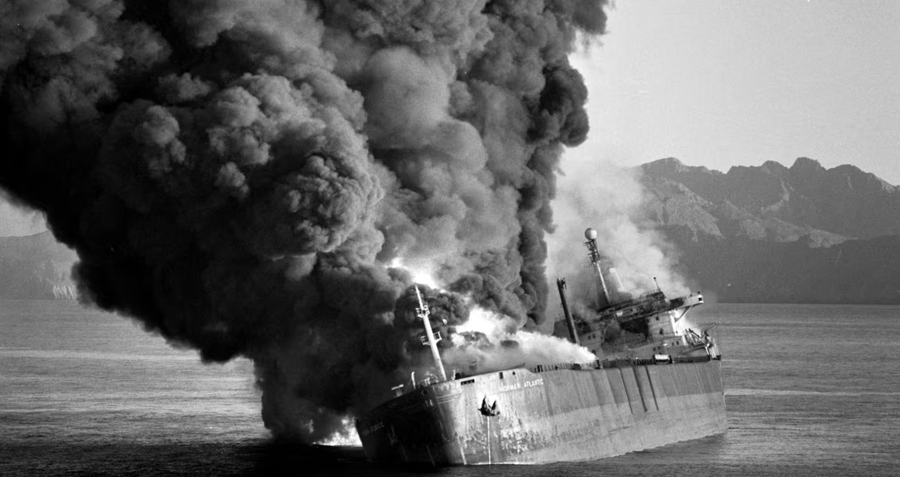
Arild Syvertsen is one of many retired sailors reliving traumatic memories from the Strait of Hormuz amid the current crisis in this waterway.
"We are experiencing the return of [Post-Traumatic Stress Disorder] during this war," he told Radio Free Europe from his home in Norway. Syvertsen said that "sailors who were there in the '80s are going through a difficult period because all the memories are coming back."
Syvertsen commanded ships through the Strait of Hormuz during the peak of the Tanker War, a conflict from 1981-1988 that resembles today's crisis in the Persian Gulf, reports A2.
The Tanker War was an offshoot of the Iran-Iraq War, which began in 1980 with Iraq's invasion of Iran. The conflict quickly spread to the waters of the Persian Gulf, as Iraq, and later Iran, targeted the other side's oil facilities and maritime transport.
By the mid-1980s, Iraq, using aircraft acquired from France and anti-ship missiles, attacked neutral vessels transporting Iranian oil, while Iran used naval frigates and fast boats to assault oil tankers from third countries that used the ports of Kuwait and Saudi Arabia. Both Arab nations had supported Iraq in the war.
Hundreds of ships were attacked during the maritime conflict, and more than 100 merchant sailors were killed.
Despite the risks, sailors were persuaded to serve on tankers passing through the Persian Gulf, partly due to danger pay, which in some cases doubled their daily wage for time spent in hazardous waters. Syvertsen said even senior crew members felt a duty to keep energy supplies moving through this vital waterway.
"We wanted to do our duty because the shipowners told us we had to keep the Strait of Hormuz open and transport energy, otherwise the entire world economy would collapse," he expressed.
Olav Myklebust worked as an engineer on ships sailing the Persian Gulf during the 1980s and survived two attacks by Iraqi aircraft. During one of these attacks, near the shores of Dubai, an anti-ship missile passed very close to his vessel before striking another nearby floating craft, killing several people inside the engine room. He continues to work today as a manager for oil tankers.
This industry veteran said the same tactics used by ships in the '80s to avoid detection are likely being adopted by some vessels that have passed through the Strait of Hormuz recently.
Tankers in the Persian Gulf in the '80s moved mostly in darkness, he said. "No lights, no lamps," and all the crew cabin windows were covered. "We hardly used the radar at all, only occasionally, because it could give a signal to the shore. They will do the same today, they will pass stealthily."
He added that ships might turn off transponders used to avoid collisions, as these devices also reveal the ship's location and appear on maritime tracking websites.
Syvertsen, who has written a book about the conflict, remains deeply affected by a decision he made as captain of a tanker heading towards the Strait of Hormuz in August 1987.
Sailing at night through the Persian Gulf, Syvertsen's ship had extinguished all lights and halted signals as he tried to pass unnoticed with his ammonia tanker through the Strait of Hormuz.
Suddenly, a light was seen at sea, indicating that another vessel attempting to pass similarly, in secrecy, was being attacked by a group of Iranian fast boats.
"We saw the missiles and heard the radio. The captain was desperate," recalled Syvertsen. As a distress call came over the radio, the retired sailor said: "I was conflicted." Turning back to offer help was almost suicidal, but the Norwegian could offer assistance via radio, responding to the request.
"But, I knew that if I called and sent a message, the attacking Iranian ships would realize another tanker was nearby," said Syvertsen. He made the decision to remain silent.
"I had to think about the 24 other people on board our ship and just continue in darkness without responding."
After hundreds of ships were attacked by Iraq and Iran during the '80s, the USA sent warships to escort tankers through the Gulf. However, the intervention had tragic consequences. In May 1987, the American warship USS Stark was hit by missiles fired from an Iraqi aircraft. Baghdad later said the pilot mistook the warship for a tanker. Thirty-seven American sailors were killed in this incident.
A year later, after "liberalized" rules of engagement were established for American ships escorting tankers in the Persian Gulf, the warship USS Vincennes mistook an Iranian passenger plane for a military aircraft.
After warning the aircraft to change course, Vincennes launched two missiles that caused the plane to disintegrate in the sky. All 290 people on board were killed.
The Iran-Iraq War ended in August 1988, and a month later, American warships ceased the tanker escort operation in the Persian Gulf.
Veterans of the '80s Tanker War today said the Strait of Hormuz could be forcibly opened by the U.S. Navy. But Syvertsen said he believes such a move "would only worsen the current conflict."
Myklebust recalled an incident in July 1987, when a tanker being escorted by American warships hit a naval mine, using this case as evidence that "even with one of the world's most powerful navies, the environment cannot be fully controlled."
On April 12, American President Donald Trump said the U.S. Navy would begin blockading the Strait of Hormuz, preventing passage even to ships that have paid Iran a transit fee.