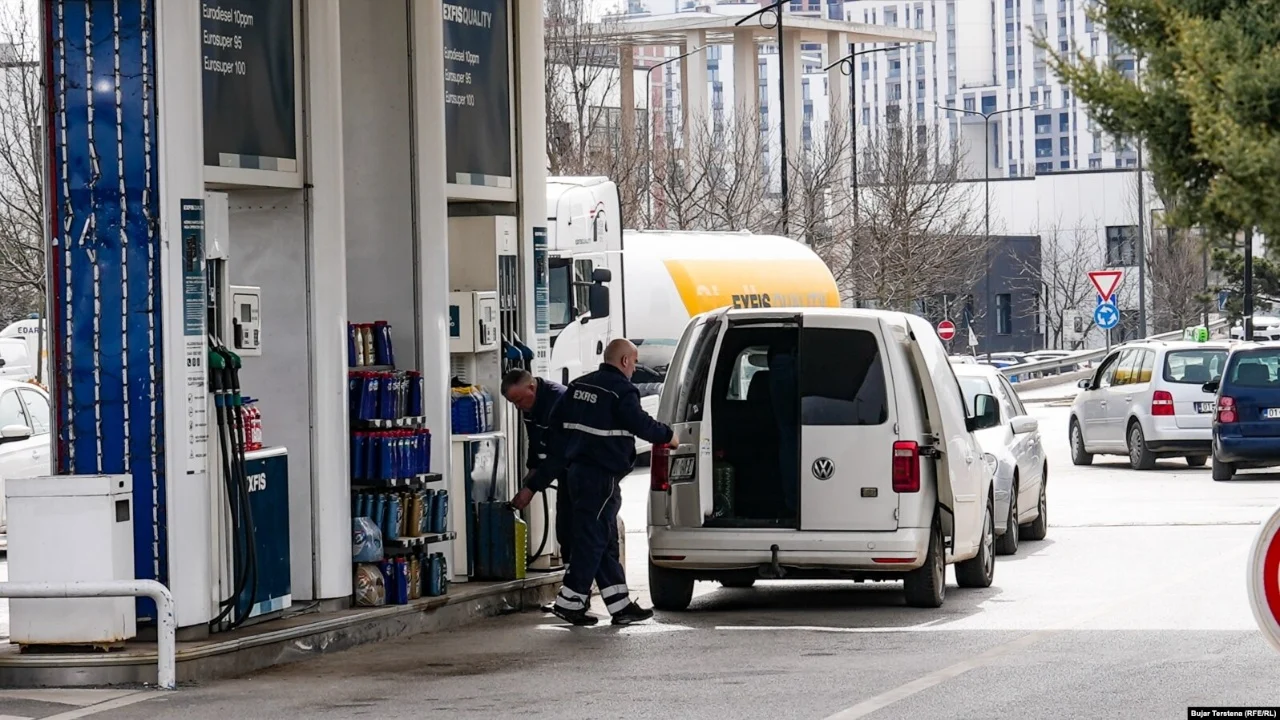
Kosovo implemented a protective measure on Saturday for the price of oil derivatives, as the price of oil continues to rise in the country due to the conflict in the Middle East.
The Minister of Industry, Entrepreneurship, and Trade (MINT), Mimoza Kusari, announced on Facebook that the decision to extend the measure initiated on March 3 went into effect on Saturday.
The measure aims to set maximum allowable profits for wholesale and retail sales and prevent uncontrolled increases, but it does not imply that there will be no price hikes, as this depends on import prices. According to the decision, the maximum allowable trade margin for wholesale sales will be up to 2 cents per liter, while for retail, it will be up to 12 cents per liter.
Kusari emphasized that, according to current data, diesel entered customs at a price of 1.77 euros per liter, and with excise and VAT, it can be sold for no more than 1.91 euros per liter.
Meanwhile, gasoline entered customs at 1.30 euros per liter, while in the domestic market, it can be sold for no more than 1.44 euros per liter. The price of a liter of diesel at fuel stations in Kosovo reached over 1.84 euros on Saturday, compared to 1.33 euros on March 3, three days after the start of attacks by the U.S. and Israel against Iran.
Kusari stated that the decision provides for increased oversight by the Market Inspectorate, in cooperation with the Kosovo Customs and the Kosovo Tax Administration, as well as close coordination with the Competition Authority.
"I call on all economic operators to respect this decision. Any violation will be addressed with punitive measures, including retroactive penalties from the Market Inspectorate and the Kosovo Tax Administration," she said.
The price increases for derivatives began a few days after the United States and Israel launched a military operation in Iran, and Tehran responded with attacks on Israel and other U.S. allies in the region. Following these tensions, the price of Brent crude, the global benchmark, rose by up to 10 percent on March 1, and analysts expect further increases. Uncertainty over supply disruptions intensified, especially after a portion of shipments through the Strait of Hormuz were suspended.
This strait, through which over one-fifth of the world's daily oil supplies pass, serves as an export artery for countries such as Iran, Saudi Arabia, Kuwait, and Iraq.
Any risk of blockage or restriction of traffic immediately translates into higher insurance and transportation costs and, consequently, higher prices in global markets. Kosovo depends on the import of oil derivatives as it has no refineries of its own. Last year alone, the country imported over 478 million euros worth of diesel and more than 51 million euros worth of gasoline.
After every global crisis, economic operators in Kosovo have raised the prices of derivatives, even for quantities purchased earlier at lower prices.
To prevent price abuses, the former director of Kosovo Customs, Naim Huruglica, said last month for Radio Free Europe that authorities should consider extending protective measures to ensure fair competition and consumer protection during crises.
The ruling party of Prime Minister Albin Kurti, Vetëvendosje, did not support an opposition resolution on Friday to reduce excise taxes and remove VAT on diesel, stating that this would not have a positive impact on citizens.