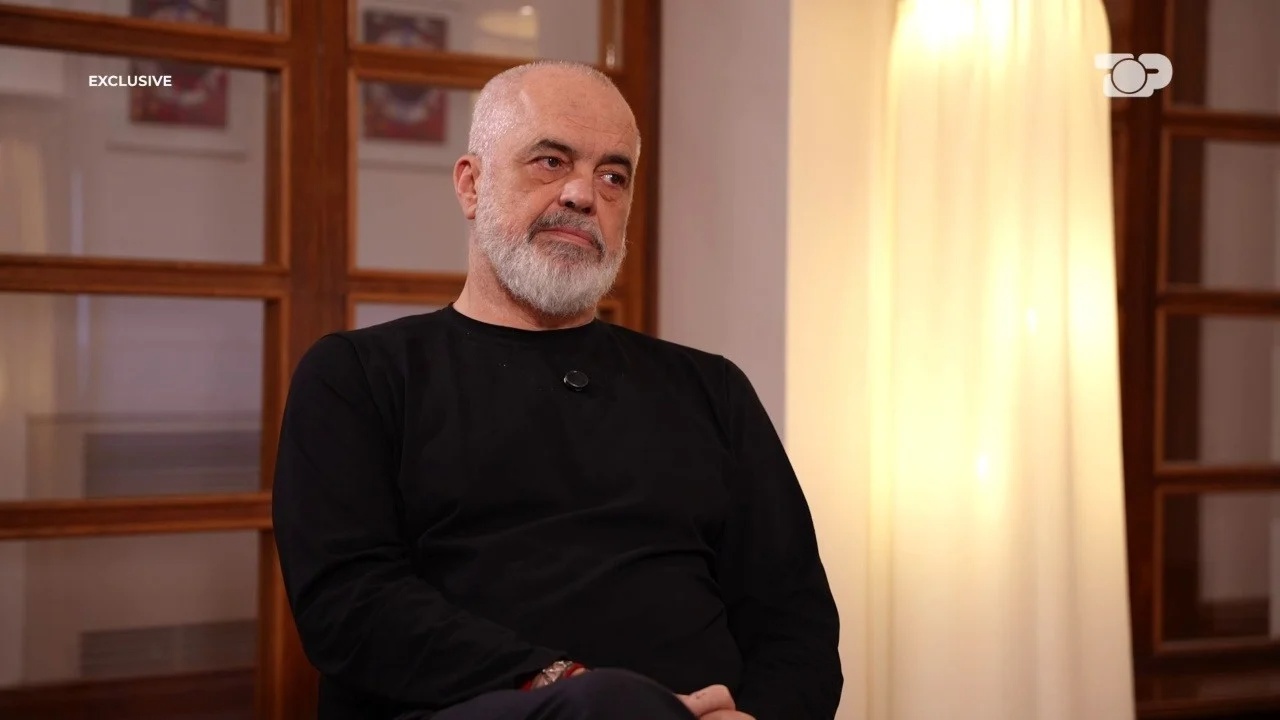
Prime Minister Edi Rama has once again presented the public with a book. This time he has written "At the Monday Table," a collection of speeches he delivered during Iftar dinners. In an interview with Monika Stafa on "Exclusive" on Top Channel, he spoke more about the book and other topics.
When asked whether Albanians are as valuable and of such quality that they deserve to be consolidated partners within the European family, Edi Rama says that every nation has its own forces of light and darkness.
However, according to him, there is a reason why Albanians should be proud of their ancestors: "the way they managed to stand and survive while being threatened, and not just once, by disintegration, dissolution, assimilation," Rama expressed.
Stafa: In your speeches you highly value Albanians, so much so that one often thinks you exaggerate, also criticizing this European club that does not see us as so dear, as such consolidated and integrating partners as you write. Do you truly believe that Albanians are as valuable and of such quality that they deserve to be consolidated partners within this great family that is Europe? Where does this belief come from?
Edi Rama: I don't know exactly if I overvalue Albanians in the general sense, because I don't believe in general assessments of peoples, of nations. I say that every nation has its own forces of light and its own forces of darkness. Every nation has its extraordinary people, it has ordinary people who are generally very similar in their being regardless of skin color, regardless of language, regardless of geography. But in some aspects, I think we have reasons to be proud of our ancestors. And one of these aspects is the way our ancestors managed to stand and survive while being threatened, and not just once, by disintegration, dissolution, assimilation. Another is the way our ancestors protected the Jews during the Second World War... this is something unique. And what makes it unique is the fact that it is comparable, meaning Albanians did it but many other peoples and nations did not. But also then the way certain people, specific Albanians in history, managed to do things that at the time they did them seemed completely impossible. So, I don't believe and hope that I do not idealize our people, because that doesn't help. But on the other hand, I am grateful to fate that I am Albanian and not something else. And if I had to choose, I would choose to be Albanian again.
Stafa: You constantly mention the part of religious coexistence, not only as propaganda, but also as our added value, as a cultural treasure. When you speak about it in the international arena, do they view you with skepticism or doubt?
Edi Rama: I mention it and perhaps I should mention it even more, because I consider it simultaneously a very important security system for peace, for the uninterrupted continuity of our people, because there are countless cases where the religious diversity of a community has created extraordinary wounds, has brought death, has brought destruction, has brought irreparable turmoil. And it is like something extraordinary that when you have it you don't value it. There are many extraordinary things that we have and do not value. Humans are not inclined to value what they have. We are not even inclined to imagine that you could wake up in the morning and might not see anymore, and we take for granted that certainly when you wake up in the morning you can see the light. But how many people are there who just to see the light once would be willing to give their life, because they are blind. We don't value when we wake up, that we have the day ahead, that in its simplicity, or with the things we have that seem ordinary to us, that we have family, that we have a home, that we have friends, that we can sit at a table where we can eat and talk about something, how many people would be those who just for this day would give their whole life? As many as you want. So, from the simplest to the more complicated, when we have them we don't value them. But we should never forget and I never forget, what a hell Albania would be if this brotherhood, or this religious harmony as Pope Francis called it when he came here, were to disintegrate and in its place there were discord, conflict, war, it would be a disaster. As for foreigners, I believe they have now perceived and made their own an image of Albania that is much closer to reality, than the image they had not many years ago, when they respected us formally, when they neither believed in us nor valued us. And meanwhile they again need to hear more about the brotherhood, about religious harmony, about what we did for the Jews, about how much we are committed to the West, about how much we as a nation and as a country have suffered from the past, from the dictatorship, about how we learned everything in the extreme due to the fact that we were on the wrong side of history, when we isolated ourselves and aligned with dictators, with the bloodthirsty of the world. These are things we should help them see and know about us.
Stafa: How good are Albanians with foreigners and with each other?
Edi Rama: They are better with foreigners than with each other. This is indisputable. But not just with foreigners who speak another language, but also with foreigners who knock on the door, meaning even with strangers who speak Albanian and are Albanian, they are better.
Edi Rama: It's not something that is typically Albanian, many peoples have it I believe and it's not something that... What makes us a bit more attractive in the negative sense in this aspect, is that we have it more lush, we have it noisier, we have it more brutal the way we treat each other while others may harbor the same feeling of dissatisfaction towards others, but they don't express it so brutally. I believe this has been aggravated especially by isolation and then also by humiliation. But it's not something typically Albanian I believe.