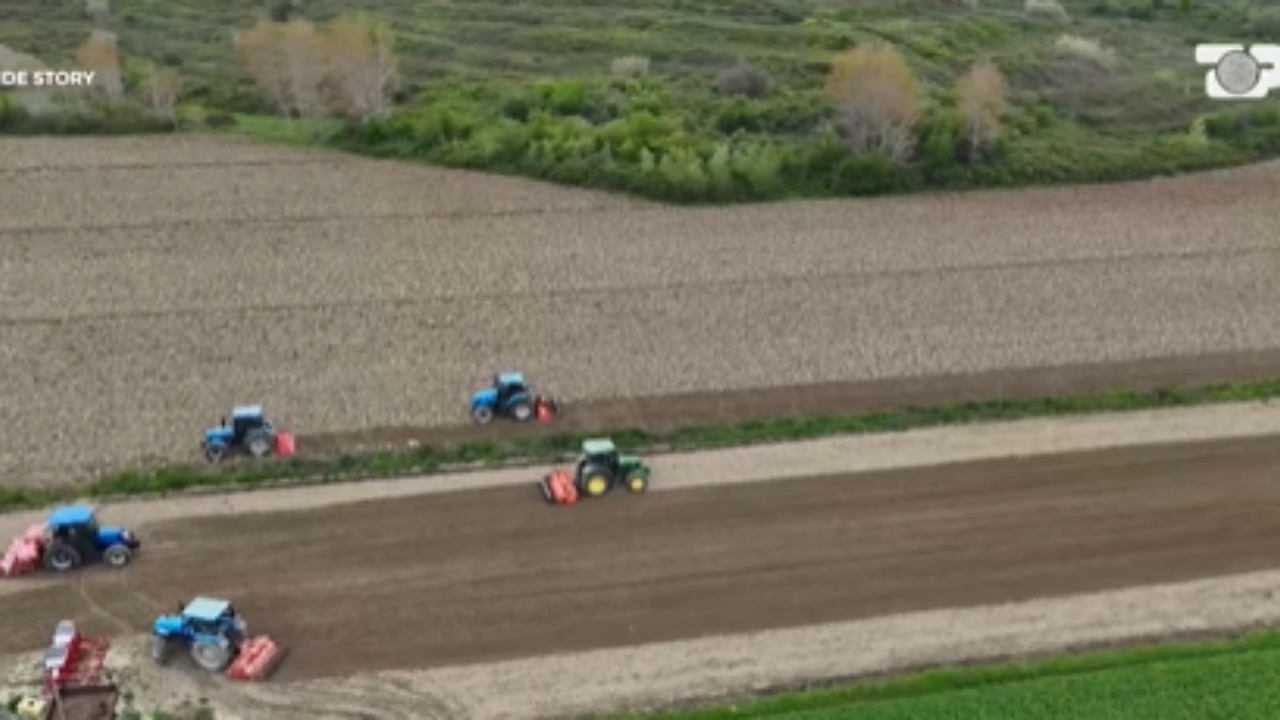
In the village of Jubë in Durrës, the three Balla brothers have dedicated their entire lives to agriculture. Currently, they own over 300 hectares, of which 170 hectares are their property, while the rest is leased. Flamuri, the eldest among them, says he has been on a tractor for more than 40 years. "We face various problems, mainly dealing with wheat, corn, alfalfa, and beans," said farmer Flamur Balla. None of the three brothers have considered emigration as an option, choosing instead to build their future on the land of their ancestors. In some periods, agriculture has generated significant income for them, which they have reinvested in purchasing various machinery. The problem is that they are facing a shortage of labor. "It's difficult to find workers; here are the machines, but no one comes to work," expressed farmer Flamur Balla. The floods of January 2026 caused considerable damage. They had planted about 100 hectares with wheat, but 60 of them were taken by the Erzeni River... This is what remains. "They came, saw it, did the paperwork, measurements, but we still haven't received anything... Let's hope," said farmer Flor Balla. The Balla brothers say they have rarely applied to benefit from support schemes due to the limitations these schemes have. The lack of documentation often leads landowners to apply for the schemes, rather than the farmers who lease and cultivate the land. "I don't think we will apply; there is too much paperwork. We lose more time, and agriculture doesn't have time to waste," expressed farmer Flor Balla. These farmers, who cultivate wheat—a product that paradoxically we largely import—also find the support scheme of 10,000 lek per hectare disappointing. For them, this scheme becomes even more meaningless amid the crisis in the Middle East, a crisis that led to a drastic increase in oil and chemical fertilizer prices. Faced with natural disasters and successive crises, the sector remains almost unprotected. Damages from floods or livestock diseases are often not compensated, pushing farmers toward abandoning their activities. "Natural disasters, wars, or crises have not only affected farmers and livestock breeders in Albania. They have equally affected farmers and livestock breeders in Kosovo, Macedonia, Montenegro, Serbia, and all of Europe. But that is why the state is there; the state is the guarantor that compensates for natural disasters and then gives farmers the opportunity not to abandon the land, so they can stay and produce," said the president of the Veterinary Order, Ervin Resuli.
Society
Four decades on a tractor, the 'bread' farmer: 60 hectares of wheat submerged by Erzeni, no compensation...
In the village of Jubë in Durrës, the three Balla brothers have dedicated their entire lives to agriculture. Currently, they own over 300 hectares, of which 170 hectares are their property, while the rest is leased. Flam
ingestionalbania