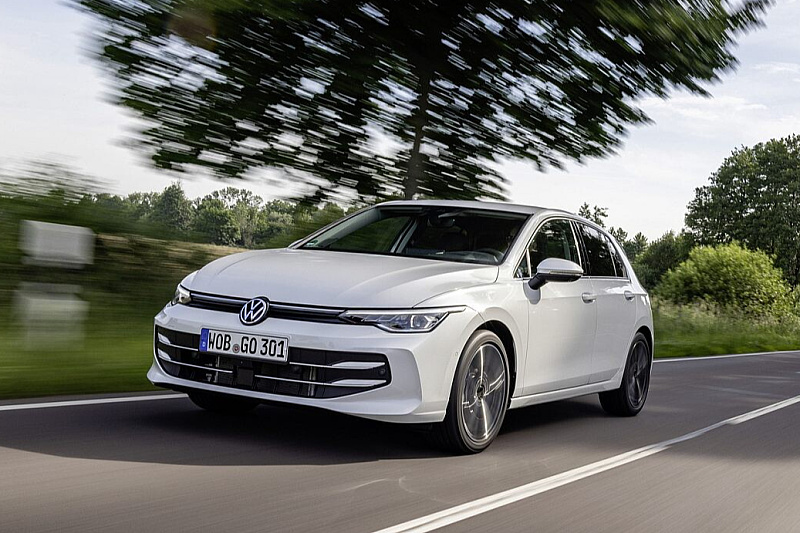
In an era of electrification, the Golf diesel demonstrates that efficiency can still be simple and highly cost-effective. In a routine test conducted by the Motor1 editorial team on the well-known Rome–Forlì route, the Volkswagen Golf 2.0 TDI 150 HP DSG R-Line Plus reaffirms its benchmark status in the class for driving characteristics, technology, build quality, and exceptionally low fuel consumption, even in 2026. Since its inception, the Volkswagen Golf has been one of the key models in popularizing diesel engines. The German manufacturer Volkswagen has offered diesel versions of this model for over 50 years, and although they are now under pressure from increasingly strict environmental regulations, diesels still hold their place in the market.
Average consumption of 3.5 liters Although diesel cars are no longer as dominant as they once were, the Golf is still available with a 2.0 TDI engine. This very variant was the subject of this real-world fuel consumption test on the well-known route where many cars have been tested. With its achieved result, the Golf ranks among the top three diesel cars in terms of real-world fuel consumption. It outperforms models like the Mercedes A180 d Automatic and the BMW 118d, with only the Mercedes B 180 d and newer A-Class variants achieving better results.
In mixed driving conditions, which include city and open roads, the average consumption is around 5.4 l/100 km, allowing a theoretical range of approximately 925 kilometers on a single tank. On the highway, where engine loads are higher and speeds are consistently high, consumption increases slightly to about 5.6 l/100 km, with a range of around 900 kilometers. However, the true strength of this diesel model shines in economical driving on open roads, where consumption can drop to as low as 3.0 l/100 km. Under such conditions, the total range exceeds an impressive 1,600 kilometers, placing this model among the most efficient cars in its class.
From a full tank to the "moon and back" During the test, the actual average consumption was 3.5 l/100 km, while the trip computer showed a slightly higher value of 3.6 l/100 km, and the pump measurement was even lower—3.4 l/100 km. Such consistency confirms the precision of the system and the realism of the achieved results. When translated into costs, it’s clear why diesel still makes sense for drivers covering longer distances. The total fuel cost for the 360-kilometer test route was only 22 euros, while the average monthly cost for around 800 kilometers of driving would be just under 50 euros.
Additionally, with just 20 euros worth of fuel, it’s possible to cover about 327 kilometers, while a full tank with an average of 3.5 liters enables a range of over 1,400 kilometers, further confirming the economy of this model.