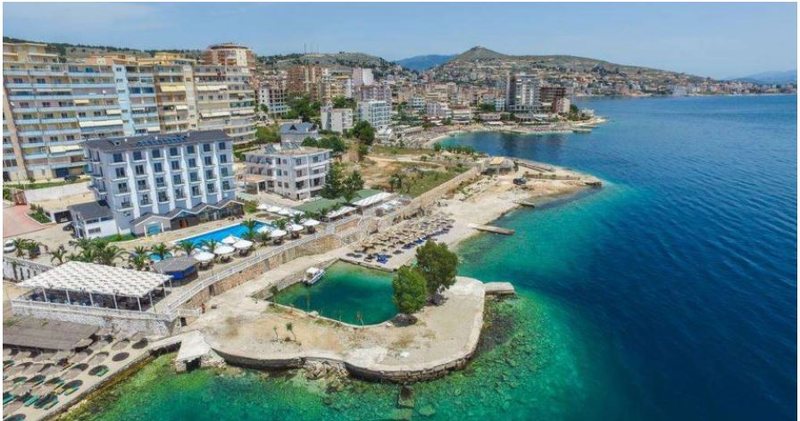
The downturn in Dubai's real estate market due to the Middle East conflicts is transforming into a new opportunity for Albania's coastal areas, particularly Vlorë and Sarandë.
According to real estate agent Eron Çumani, many international investors who previously utilized Dubai for property purchases are now turning to Albania, seeing it as a safer alternative with potential growth.
"All capital placed, whether formally or informally, is often invested in real estate. In Dubai, after the start of the war in the Middle East, 30 to 70% of properties have lost value," says Çumani. He emphasizes that Albania is not exposed to conflicts or wars, and for this reason, many foreign investors who once invested in Dubai are considering the Albanian Riviera as a new destination for their investments.
"The initial phase of interest is already emerging, where some companies that bought properties in Dubai are exploring the possibility of investing in villas and apartments in Albania, aiming for capital return through rentals or property value appreciation. This trend is expected to increase demand and gradually impact property prices in the country's premium coastal areas.
How Dubai was hit by the Middle East war
Dubai became very attractive for real estate in recent years because it was perceived as a safe haven for international capital, with very low taxes, ease of doing business, and a market offering high returns from rentals and property value growth.
Reuters wrote that for decades Dubai's strength has been precisely its image as a stable place in a tense region, while investors were also drawn by modern infrastructure and a climate friendly to foreign capital.
In recent years, this interest has been further fueled by high sales of properties under construction and the entry of foreign buyers seeking not only profit but also geographical diversification of their investments. Precisely for this reason, any blow to Dubai's perception as a "safe port" has started to push a portion of this capital toward alternative markets.
Recent developments indicate that Dubai's real estate market is going through a more complicated phase than a linear decline. Reuters reported in March that the sector was showing the first signs of weakening, with transaction volumes in the United Arab Emirates falling 37% year-on-year in the first 12 days of the month and 49% compared to February, while in some cases in the market, price drops of 12% to 15% were appearing for quick sales.
According to the same report, the conflict has hit Dubai's image as a safe haven for international capital and increased the risk of a broader market correction, especially since there were already concerns that after five years of strong growth, the property cycle was entering a slowdown phase.
Precisely in this climate of uncertainty, smaller and developing markets, like Vlorë and Sarandë, are gaining increased attention as alternative destinations for capital seeking high returns and lower exposure to regional tensions.