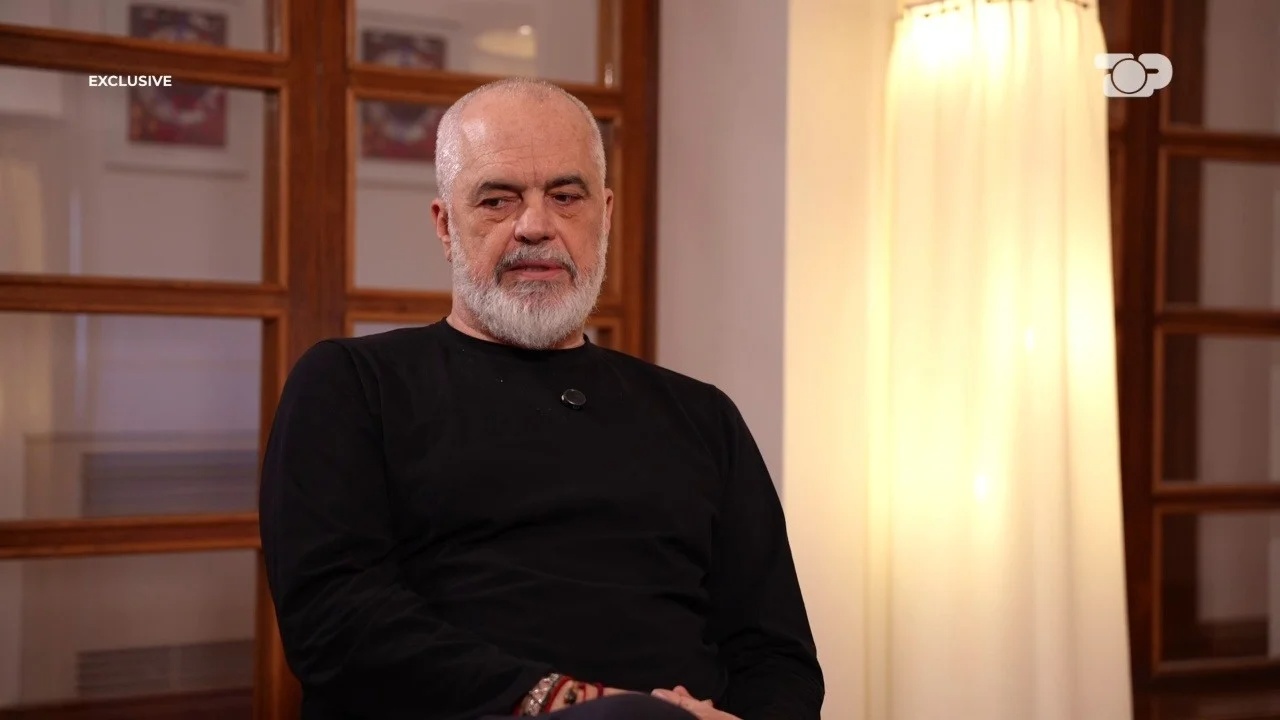
Edi Rama says he is not someone who frequents temples, although when asked "do you believe," he responds, "I have never felt comfortable talking about something as personal as faith in this aspect." During the interview with Monika Stafa on "Exclusive," he believes that the rise of the internet's power has not diminished people's faith in God. Monika Stafa: In one of your speeches in the book, I read that in this religious space, there is also room for those who do not believe. Do you believe, Mr. Prime Minister? Edi Rama: I have never felt comfortable talking about something as personal as faith in this aspect. I am certainly not someone who frequents temples; of course, I view them with great respect, with great curiosity, but I do not frequent them. However, when it comes to faith itself, I do not feel comfortable speaking because it is something difficult to express, as it is very personal. People see and understand the existence of something that is referred to by different names, but in all cases, there is a common denominator: faith in a power, an energy, a space beyond oneself. So, I find it very difficult to talk about it. Stafa: We now live in a different time before the pandemic; we are full of anxiety and uncertainty due to technological development, which has done us good but also has a downside with many inappropriate news, fake news, leading to an increased crisis in worldview... am I right in this observation? What is the relationship today between human faith and what one should believe in? This technological young person? Edi Rama: I do not believe that people today have less faith than before the advent of the internet; in fact, there are studies that say the increase in scientific power to explain phenomena has not diminished people's faith in God. On the contrary, there are more people today who believe in God than before this explosion. However, perhaps a part no longer believes in the path of the Church, the Mosque, the Synagogue, that is, in temples, in institutions. This is also linked to a general crisis of institutions in general, of the state in general, especially in countries where there is freedom, democracy. Meanwhile, there are many people who believe in faith in the sense that they believe believing is not something wrong. Stafa: Why does a person need this? Edi Rama: Often, a person cannot explain the things they want. Even science itself cannot fully explain some things. And I see nothing wrong with people believing and a person believing. On the contrary. In a sense, even the existence of communities gathered around a faith, beyond whether in that community you manage to touch or remain in the unverified search for God, is an opportunity to share within a social group, a social community, values that help a person in daily life, regardless of whether they touch or see God. Stafa: We are accustomed to religious conflicts for years, to religious divisions. But now it seems as if another division is being felt in the world, that between the rich and the poor. And between them, a high wall is emerging, a very high wall... Edi Rama: Certainly, polarization is an increasingly acute problem in capitalist societies, democracies, countries where freedom of competition and the free market, including globalization with its effects, have led wealth to be concentrated in fewer and fewer people, while the gap deepens. But on the other hand, there is much data showing in many directions that the world has never been better than today, from a factual standpoint, that is, from the perspective of hunger, access to water, access to services, access to education, health, and so on. However, what makes polarization much harsher today is also the much greater proximity created by the information world, created by social platforms, where envy and consumerism have taken an almost monopolistic position in everything seen and consumed in the sense of rich people, wealthy people, well-dressed people, people equipped with houses, cars, planes. Meanwhile, the other part sees very clearly the great gap that separates them from this elite, and this greatly increases the sense of conflict. Stafa: In this book, how many calls for human love are there in these speeches, how much weight do the truths spoken there carry? Edi Rama: When I decided to make the first invitation for an iftar here at the Prime Minister's office, to be honest, I did it as a step toward a community that, for various reasons, has often felt prejudiced as a result of prejudices against Islam. Let's not forget in Europe and the West, these have deepened especially after the attack on the Twin Towers and all the stereotypes that linked Islam with terrorism and Islamism and the Muslim faith, Muslims, with organic incompatibility with the West. And beyond that, it's not that I had any deep reflection that came to me step by step and year by year, reaching the point where I have not only patience but also look forward with great pleasure to that iftar dinner. And there is something very beautiful about that ritual, and I now understand very well the strict, educational part that Ramadan has for those who follow it and the deeply healthy part of the practice of Ramadan, which is truly very impressive for its effects on the physical aspect of a person, on the health aspect of a person, and on the mental aspect of a person. And of course, in this context, then the capacity of a person to produce positive energy toward others is much greater than on ordinary days, just as negative energies themselves decrease compared to ordinary days.
Society
"The internet has not shaken people's faith in God," Rama: Despite the depth of the gap between the rich and the poor...
Edi Rama says he is not someone who frequents temples, although when asked "do you believe," he responds, "I have never felt comfortable talking about something as personal as faith in this aspect." During the interview
ingestionalbania