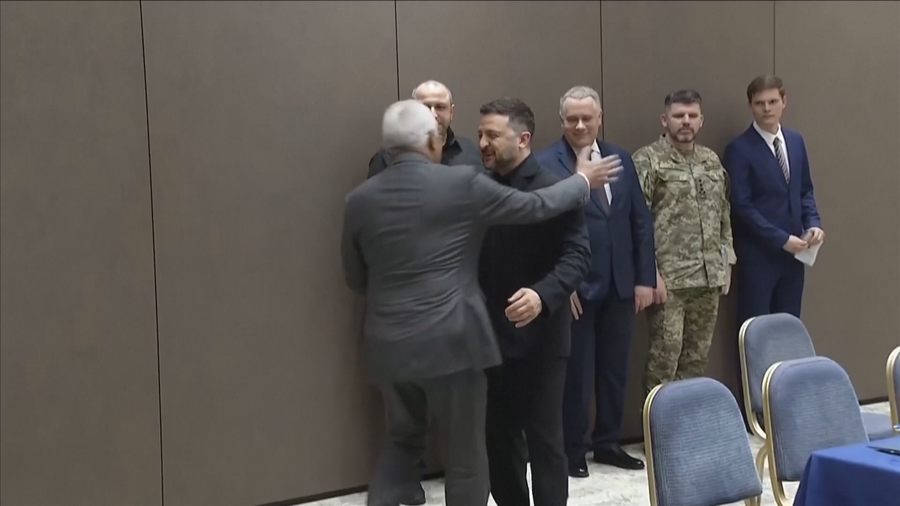
The European Union officially approved a 90 billion euro loan for Ukraine and new sanctions against Russia on Thursday. The loan will cover two-thirds of Ukraine's needs for the next two years. Economists had said that Ukraine would start running out of money by June if the EU loan was not disbursed by then, requiring deep cuts in public services.
Only half of the 90 billion euros will be disbursed to Ukraine this year, with the remainder coming in 2027. Most of the loan is intended for military spending, with about 17 billion euros each year earmarked for general budget needs, such as healthcare and education.
European Commission President Ursula von der Leyen told Ukrainian President Volodymyr Zelenskiy on Thursday that the EU had fulfilled its promise of a 90 billion euro loan during a meeting in Ayia Napa, Cyprus. "Today is a good day for Ukraine and for Europe," von der Leyen said.
"The more Russia doubles down on its war of aggression, the more Europe doubles down on supporting Ukraine," she added while speaking to the media ahead of an informal meeting of EU member state leaders in Cyprus.
French President Emmanuel Macron expressed satisfaction with the approval of the package for Ukraine.
"The approval of the 90 billion euro loan for Ukraine, which was agreed upon last December, will now become a reality, and that is a very good thing. And I trust your leadership (the Cypriot presidency of the EU). And we will have the opportunity tonight, since President (Ukrainian) (Volodymyr) Zelenskiy is invited, to continue exchanges with Ukraine, the plan to support Ukraine, to exert pressure on Russia both through new sanctions and through actions targeting the Russian shadow fleet."
French President Emmanuel Macron said: "Macron added that EU leaders aim to pursue exchanges on how to continue supporting Kyiv and maintaining pressure on Russia, including targeted sanctions on its shadow fleet, with Ukrainian President Volodymyr Zelenskiy, who will attend the bloc's two-day informal meeting in Cyprus."
Ukraine's budget projects a massive deficit of about $43 billion in 2026 – roughly one-fifth of economic output – but economists say that significantly underestimates the cost of the war with Russia.