Everyone wants them, but no one sells them... The Gulf conflict has brought back into focus the role of drones, the undisputed protagonists of modern warfare. Yet even four years after the invasion of Ukraine, which highlighted their importance, there remains a large gap between demand and supply. The reason is simple: low-cost systems do not interest American and European giants, who aim for equipment with much higher profit margins, looking toward future military drones or unmanned vessels. The market for autonomous weapons operating on land, sea, and air is projected to grow from $47 billion last year, largely driven by the Trump administration's policies, to $98 billion by 2033. In the world of flying drones, the most sought-after are divided between the "Old Testament" and the "New Testament."
"The Old Testament": Large American and Israeli drones Since 2001, the scene has been dominated by large, expensive unmanned aircraft. The Predator was the pioneer, an icon of the Global War on Terror, followed by the Reaper. For more than a decade, the armed version was an American monopoly, produced by General Atomics, which recorded $3.2 billion in revenue in 2025. After them came Israeli companies: Elbit with the Hermes and IAI with the Heron. The market expanded to Turkey with Baykar and the TB2 drone by Selçuk Bayraktar, which was exported to 36 countries. These drones are expensive: a Reaper costs around €30 million, the TB2 and Heron about a third of that, plus satellite systems for navigation. But modern wars, like the offensive against Iran, revealed their limitations: slow, easy to detect by radar, and many were lost—over 20 by the Americans and as many by the Israelis.
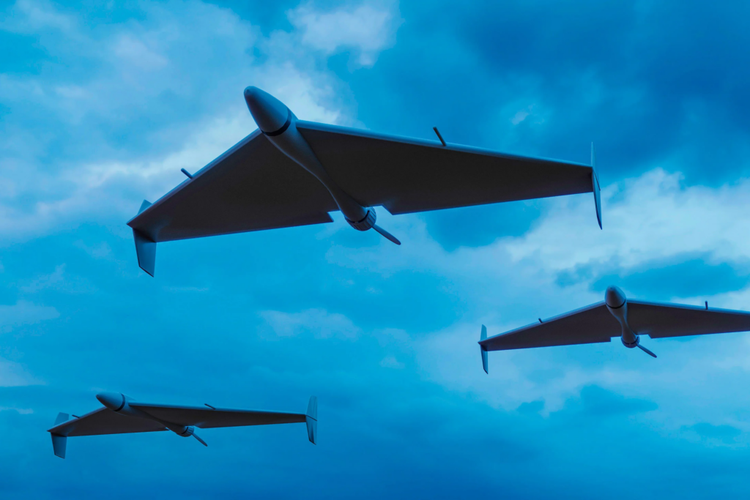
"The New Testament": Cheap and intelligent drones This type was born on the battlefields of Ukraine, where new categories were developed. The main ones are kamikaze drones, similar to flying bombs. Russia used and improved the Iranian Shahed: effective, with a range of up to 2,000 km, hard to detect, costing under €25,000. The Americans also created their own version, the Lucas, used in strikes against militias. SpectreWorks, a small company, sells them for $35,000. Ukrainians have created dozens of models, adapting them to frontline needs, with startups mushrooming since the spring of 2022. These companies have ties to the American tech industry, challenging giants like Lockheed Martin, Boeing, and Raytheon. Examples include Project Eagle, by former Google CEO Eric Schmidt, and Anduril, by Palmer Luckey and linked to Peter Thiel's Palantir. They promote the concept of the "Technological Republic," envisioned by Silicon Valley for high-tech weapons. – Short time from requirements to operation, eliminating bureaucratic delays – Low costs, thanks to the use of consumer market components – Advanced artificial intelligence New companies don't go public because there's a queue of investors. They are developing production capacity and meeting urgent demands from Gulf monarchies, especially for anti-drone drones. Only Anduril and Project Eagle are managing to meet them. Europe is not keeping up with the rapid pace of sector development: defense ministries are tied to multi-year plans and cannot adapt quickly to the speed of changes in modern conflicts. However, some companies are thriving, like Germany's Tytan, which is transforming automotive plants for anti-drone drone production. Other companies are unveiling reconnaissance or attack drones: Germany's Helsing and Stark, France's Harmattan AI, Portugal's Tekever, or the Netherlands' DeltaQuad. In Ukraine, TAF Industries and UkrSpecSystems operate, while Skyeton has a branch in Slovakia. Though small, mini-bomb drones are widespread in Donbas, built with Chinese parts or 3D-printed, costing only €1,000 to €2,000. Ukraine shows that every six months, innovation quickly makes drones obsolete, creating a paradox: you cannot order tools that will become useless before use. This requires changes in procurement and contract organization to get the right tool at the right time.