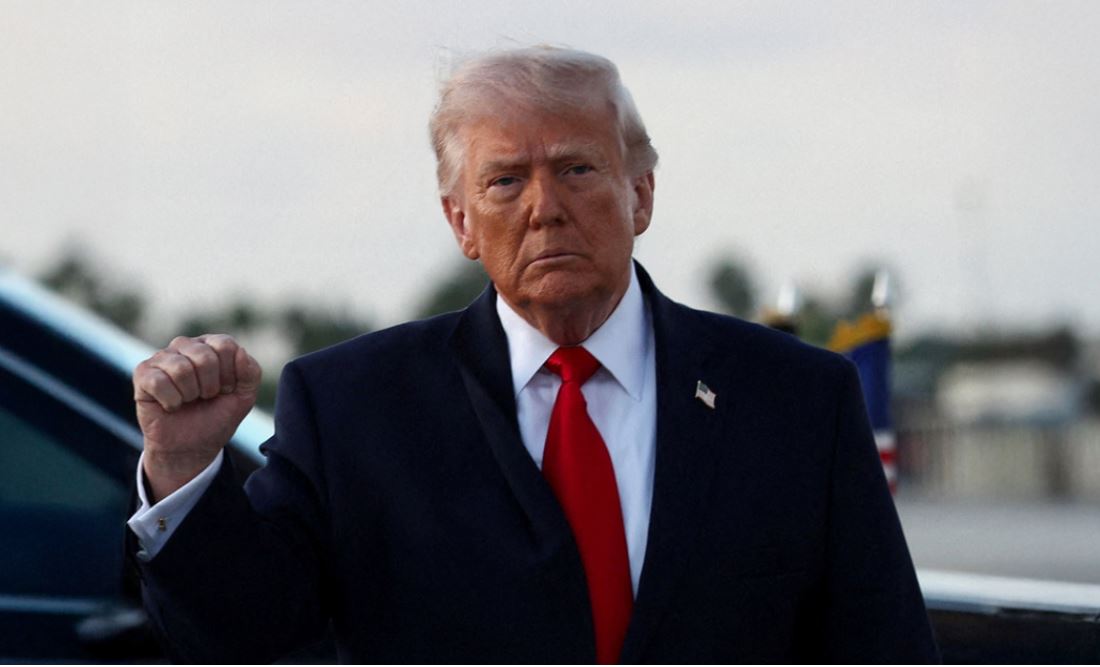
U.S. President Donald Trump issued a strong warning regarding the situation in the Strait of Hormuz, declaring that any vessel approaching the blockade zone will be immediately struck. His statement comes at a time when Washington has officially imposed a naval blockade on Iranian ports.
Trump claimed that the Iranian navy has been "completely destroyed," adding that 158 Iranian vessels have been sunk. He also warned that the remaining ships, including fast-attack craft, will be targeted if they approach the blockade zone.
The naval blockade against Iran took effect at 17:00 (Greek time), following the failure of efforts to reach an agreement that would end the war in the Middle East. The decision was confirmed by the United States Central Command.
According to U.S. authorities, the blockade extends to the Gulf of Oman and the Arabian Sea, east of the Strait of Hormuz, and applies to all vessels, regardless of the flag they fly. Any maritime vessel entering or leaving the area without authorization risks being stopped, diverted, or seized.
However, it is emphasized that neutral passage through the Strait of Hormuz to non-Iranian destinations will be permitted.
On the other hand, Iran reacted harshly, describing the U.S. measures in international waters as "illegal" and "equivalent to piracy." Tehran warned of retaliation, emphasizing that if Iranian ports are threatened, no port in the Gulf region will be safe.
Iranian authorities also announced that they will establish a permanent monitoring mechanism over the Strait of Hormuz.
Such a blockade is expected to have a significant impact on global energy markets. Iran exported approximately 1.84 million barrels of oil per day in March, while in April this figure is estimated at around 1.71 million barrels per day.
However, high reserves, with over 180 million barrels of oil already loaded onto vessels, may temporarily mitigate the effect on global supply.
Meanwhile, navigation in the Strait of Hormuz remains restricted. Many oil tankers are avoiding passage, while some vessels that attempted to cross have been forced to turn back or remain anchored.
Despite tensions, a limited number of vessels continue to operate, primarily for cargo from countries such as the United Arab Emirates and Kuwait.