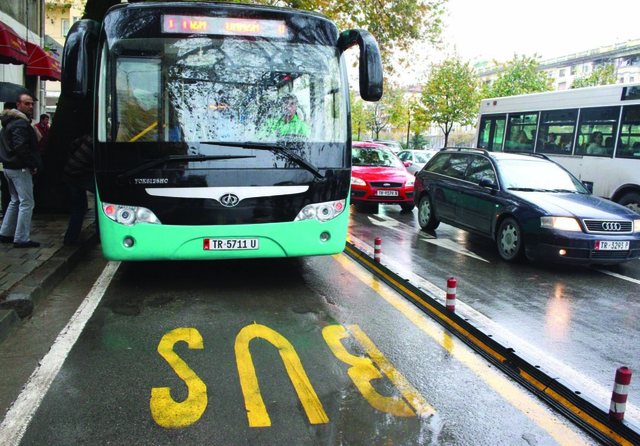
Public transport operators in Tirana and surrounding districts will continue today to operate with reduced service ranging from 40% to 60%.
The decision was made during a meeting held yesterday afternoon with representatives of operators for the country's 450 lines and leaders of the National Association of Urban Transport and the Association of Urban and Interurban Transport.
After the meeting concluded, the President of the Association of Urban and Interurban Transport, Dashnor Memaj, told "Monitor" that operators are awaiting a meeting with responsible institutions to approve their request for compensation. Otherwise, if there is no response from the institutions, measures for further service reduction will be escalated.
"Operators remain determined for the approval of their request for compensation of up to 100 lek per liter following the increase in fuel prices, a request submitted as early as the meeting held on April 1 through an 'Emergency Anti-Crisis Package' from the ministries, to avoid service reduction that has reached up to 60% at the national level. In case of no response from the institutions, measures to reduce service will be escalated," said Memaj.
On the first day of the operators' protest, the number of buses for 50 urban lines in Tirana decreased from 200 to 115 vehicles in service. Meanwhile, in the districts, the service reduction was higher. In the city of Durrës, the number of buses providing public service was reduced by 50%, in Vlora by 60%, in Berat by 60%, in Lushnjë by 50%, and in Peshkopi by 40%. Today, the number of buses in the main districts where urban and interurban public transport operates has reached up to 60%.
According to calculations by public transport associations, the increase in fuel prices has raised operators' costs by up to 800,000 euros per month, worsening their financial situation to continue with full service. Public transport associations have proposed that compensation be provided for a 6-month period, with the fund estimated at 300 million lek or about 3 million euros.
Regarding the measure to compensate for fuel prices, Kostandin Foni, President of the National Association of Urban Transport, earlier stated that the scheme is easily implementable, as it is proposed to be similar to the one implemented in 2022 during the price crisis following the war in Ukraine. He also guarantees that, in addition to the documentation available from operators for purchases and fuel expenses, consumption is calculated, as it has not changed since the 2022 period.
"The scheme is entirely implementable, as it requests the application of a direct financial compensation mechanism based on actual fuel supply invoices, tax declarations, and the verified consumption level according to licensed activity, which has not changed from the 2022 consumption. It is also a previously proven scheme during a crisis period that has worked and reduced operators' costs.
If in 2022 the state budget allocated a fund worth 500 million lek, of which 60% or about 300 million euros was used for the 6-month compensation. The calculated expenses remain the same. Thus, for this crisis as well, a fund of 3 million euros is needed for the operators," he earlier stated for Monitor.
In addition to compensation, as a primary measure to reduce costs and avoid service reduction, transport associations also request a review of the fiscal burden. This includes the removal of circulation tax and excise duty on fuel purchased by the sector, as well as a reduction of VAT from 20% to 5%.
After several consecutive letters and the meeting held on April 1, the two main transport associations, the National Association of Urban and Interurban Transport and the National Association of Urban Transport, have submitted to the Ministry of Economy and Innovation and the Ministry of Infrastructure and Energy the approval of a package with 4 fiscal measures.
For the submitted requests, operators expected a response by April 7, but so far, there has been no response from the responsible institutions. The anti-crisis package for public transport submitted to Ministers Ibrahimaj and Karakaçi.
Under the conditions of a significant and continuous increase in fuel prices, which has created a deep imbalance between the real operating costs and the unchanged revenues of the sector, we present for discussion these priority requests, supported by legal precedents and the need to guarantee an essential public service: