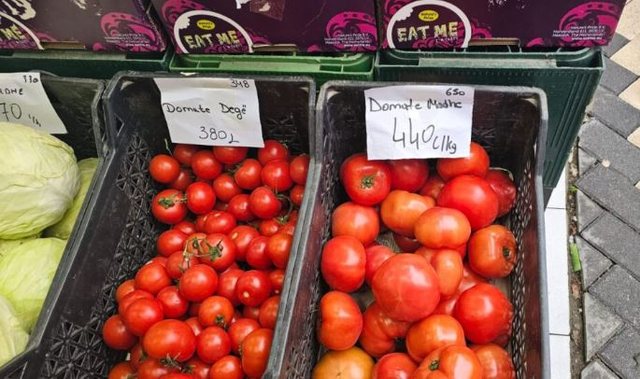
Tomatoes are the most popular product in our country, widely cultivated in greenhouses and family gardens and used in traditional recipes, but these days their price in retail markets has hit record highs of 350-440 lek per kg for regular tomatoes and 700-800 lek per kilogram for cherry tomatoes, an unprecedented value for consumers. Although this vegetable is not in season, the second greenhouse season brought this product to market stalls at acceptable prices in early April. Even in January, domestic tomatoes cost 170 lek/kg, while imported ones were 270-300 lek/kg. Now even domestic tomatoes have reached import prices.
A combination of factors, starting with reduced cultivation areas, damage caused by floods at the beginning of the year, and high export demand, are keeping prices at peak levels. Data from the market and the Farmers' Portal show that yesterday a kilogram of wholesale tomatoes at the farm cost 170-270 lek, while at market stalls tomatoes have turned into a "do not touch" product. The latest data from monitoring wholesale markets across the country by the Farmers' Portal indicate that tomato prices have experienced a sharp spike, trading at values exceeding 250 lek per kilogram in some major regions like Tirana, while in Korçë wholesale prices reach up to 300 lek per kilogram.
High prices at collection points are translating into even more burdensome figures for citizens in retail markets, where the price per kilogram has already started from the level of 350 lek, while specific varieties like cherry tomatoes reach record values of up to 800 lek per kilogram. This upward trend is also confirmed by historical analysis of INSTAT data, where a comparison of February months over the years shows that 2026 marks the highest average price level in the last four years, surpassing even the peak recorded in 2023.
Although in cities like Tirana and Fier, prices at wholesale points start from 170 to 230 lek for second-grade categories, the immediate reflection in neighborhood shops and small markets is making tomatoes a very expensive item at a time when their consumption is an inseparable part of family and restaurant recipes.
Last year, a kilogram of tomatoes during this period sold for 80-100 lek per kg at the farm and 150 lek at market stalls, but this year prices have more than doubled.
High tomato prices have triggered a price crisis for this product across the Mediterranean. Climate changes have brought temperature instability, and February floods damaged hundreds of thousands of hectares of greenhouses in Italy, Spain, Turkey, and Albania, which are currently the main producers of this product in Europe.
Greenhouses specialized for export in Fier, Lushnjë, and Berat were flooded four times from November 2025 to February 2026, completely losing a large portion of production and new seedlings.
Excess water in greenhouses caused rot, leading to the total loss of early crops, while high humidity after floods is favoring the spread of diseases like mildew, requiring additional investments in expensive pesticides, increasing the cost per kilogram at the farm, stated Mariglen Ziu, a more experienced farmer in greenhouse vegetable cultivation in Dimal.
Other factors dictating the increase are high agricultural input costs, where chemical fertilizers, pesticides, and especially [costs] have seen significant increases. Similarly, the lack of labor in rural areas has forced farmers to raise daily wages, a cost that is directly transferred to the final product price.
Many farmers, due to losses from floods, have abandoned their work. The remaining production is being directed toward export, where high demand from regional and European Union markets makes the remaining production for the domestic market scarcer and more expensive.
Additionally, the Albanian government does not provide subsidies to farmers to offset costs, unlike the Mediterranean region, which has more protective measures and financial aid for agriculture.
While other Mediterranean countries face the same climatic challenges, they have more advanced drainage and protection systems. Floods and other climatic factors in Albania hit harder due to outdated drainage canal infrastructure, making domestic production more "vulnerable" and prices more unstable compared to neighbors.