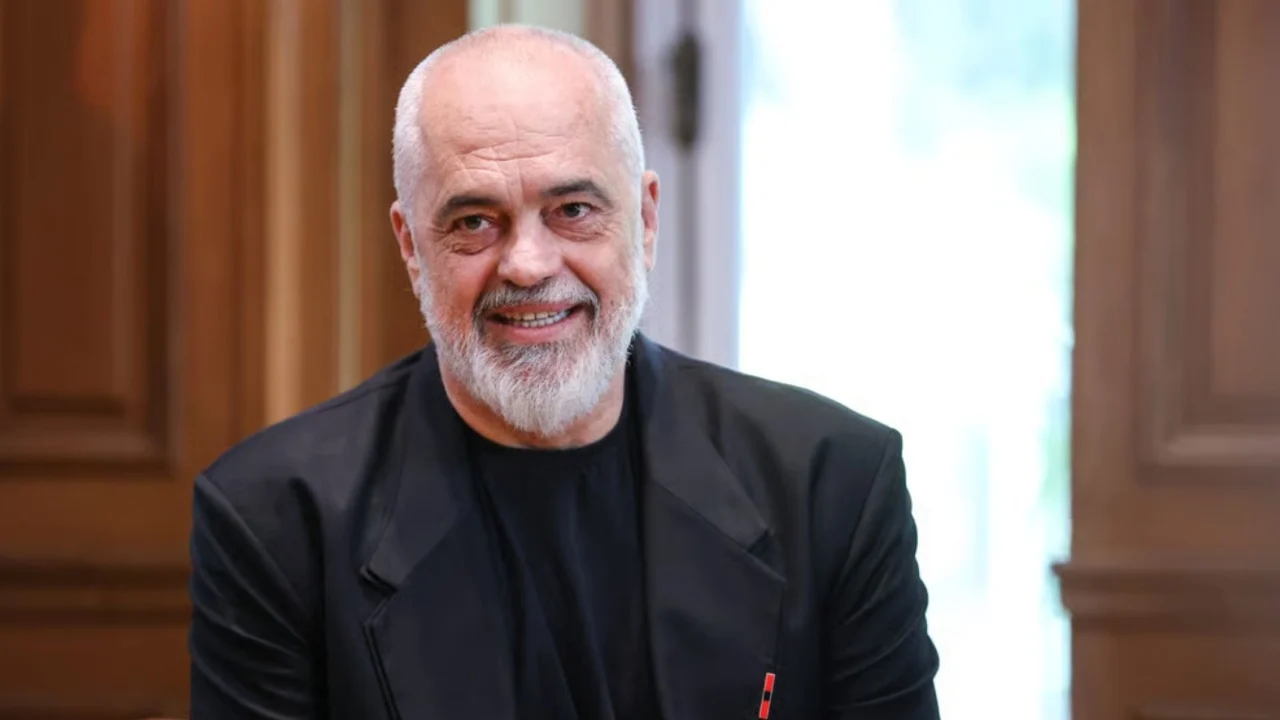
The European Union is making a serious mistake by not engaging directly with Russian leadership to end the war in Ukraine, Albanian Prime Minister Edi Rama told POLITICO. "I can say that Europe has made a major strategic mistake by cutting off all channels with Russia," he said in an interview at the Delphi Economic Forum in Greece. "Europe must always, always, always be in communication with everyone," he added.
These statements clash with the approach of senior EU officials, such as European Commission President Ursula von der Leyen and EU foreign policy chief Kaja Kallas, who have avoided direct contact with Russian leaders, including President Vladimir Putin, arguing that such talks are meaningless if Moscow is determined to continue the war.
But for Rama, whose country aims to join the EU in the coming years, Europe is sidelining itself from any future peace agreement between Ukraine and Russia by avoiding direct engagement with Moscow. "The more we delay (talks with Russia), the less say we will have in the end, because Russia, no matter how this war ends, will not disappear," he said, adding that his country has no ties with Russia. "We have no dependence on Russia whatsoever—no investments, no Russian gas, nothing Russian—so I can say this."
Rama's comments, from a former professional basketball player who blends politics with artistic creativity, come as EU leaders gather in Nicosia, Cyprus, to discuss further support for Ukraine, as well as the energy crisis facing the bloc due to Iran's blockade of the Strait of Hormuz.
During his 13 years in power, Rama has positioned Albania as strongly pro-EU while maintaining ties with the United States and President Donald Trump, whose war objectives against Iran Rama has publicly praised. "It is not for us (Albania) to decide how Iran is treated on the global stage, but it is our duty to support any effort to weaken and perhaps topple that regime," the Albanian prime minister said, adding that he would allow the U.S. military to conduct operations from Albania provided Washington ensures "air defense, which we do not have in the country."
Rama's good relations with Washington include ongoing negotiations between his government and a company owned by Trump's son-in-law, Jared Kushner, for the potential sale of Sazan Island off the Albanian coast. Kushner, through his company Affinity Partners, is negotiating to buy the uninhabited 5-square-kilometer island in the Adriatic for $1.4 billion, aiming to turn it into an eco-luxury resort with elite villas, marinas, and bunkers for wealthy visitors.
The plans have sparked strong reactions from environmental groups, with 41 organizations writing to Rama and the environment minister in January demanding an immediate halt to negotiations, arguing the plans are in "direct contradiction" with Albania's obligations in the EU accession process. Asked about these plans, Rama expressed frustration: "It's unbelievable that even major, world-renowned media talk about an island being sold to Jared Kushner. It's not true. I don't know how to stop this, because we haven't made a deal with Jared Kushner. We are in negotiations."
The sale talks began before Trump's second term, Rama added, at a time when "it wasn't clear whether he would be in the White House or in jail." However, this deal should not hinder Albania's EU membership aspirations, where, along with Montenegro, "we are at the forefront," Rama said. On the contrary, "I hope the deal goes through, because if their investment materializes, it will be a beautiful gift for Europe," he said, adding that it involves "beauty and sustainable development."
An EU official, speaking on condition of anonymity, said the European Commission is aware of the plan and had no immediate comment on its impact on Albania's accession process.
Rama, who describes himself as a "serious artist" and, at 1.98 meters tall, was a professional basketball player before entering politics, is known for his distinctive style. After expressing admiration for POLITICO's AI transcription tool ("Why don't I have this?"), Rama spent the first 10 minutes of the interview showing images of sculptures he had created partly by hand and partly with AI, which he will exhibit at an upcoming show in Berlin.
Albania drew attention by introducing the world's "first AI minister," named Diella, although the actress whose face Diella is based on has announced she will take the government to court for using her image. Rama was undeterred: "We are preparing her to appear in live interviews" as well as in "government meetings," he said.
The AI minister is part of a modernization initiative in Albania, which aims to conclude EU membership negotiations by the end of 2027 and become a full member by 2030. Rama describes EU enlargement as a process of "unification" of Europe, not the expansion of a bureaucratic union. After a meeting in Delphi with Greek Prime Minister Kyriakos Mitsotakis, whose support is necessary for Albania's membership, Rama said: "I have never seen (EU leaders) so convinced of the need to unify Europe."
However, Rama insists that Albania must have the freedom to make its own foreign policy choices, including a "sympathetic" stance toward the Trump administration. This has not prevented him from being "100 percent in line with Europe" on strategic objectives. Asked whether Albania would have to choose sides if it becomes an EU member, Rama concluded: "It's like humans and artificial intelligence. In art, you have to accept both to achieve the best result."