By Nicole Anliker, NEUE ZUERCHER ZEITUNG
Albania’s Prime Minister, Edi Rama, had big plans when he appointed a chatbot to his cabinet. Now it turns out: the bot does not appear to be effective against corruption. Ironically, its creators are suspected of being fraudsters.
Diella never sleeps, does not receive a salary, has no personal interests, and is therefore incorruptible. This is how Albania’s Prime Minister, Edi Rama, introduced the first virtual member of his cabinet last autumn.
To the minister created with artificial intelligence, Rama officially assigned responsibility for public procurement. Her task is to independently compare bids in public tenders using algorithms. According to him, she will help ensure these processes are 100% corruption-free, an area where abuse is considered widespread.
“She is my daughter,” declared Rama, “and is very loyal to her father.” He emphasized that the chatbot has no cousins, so it is not at risk of falling into nepotism, a common phenomenon. With this appointment, Rama—who has been in power for 13 years—drew international attention: Diella (which means ‘sun’ in Albanian) is the world’s first virtual minister.
However, what seems like a good PR success is part of a larger plan. Rama aims to bring Albania into the European Union by 2030, and Diella is expected to help in the fight against corruption—one of Brussels’ main requirements.
But after just six months in office, it seems the project has encountered problems: the chatbot is facing a credibility crisis and even a lawsuit.
Are fraudsters hiding behind the chatbot?
According to the government in Tirana, Diella was “born” on January 19, 2025, and was immediately introduced as the virtual assistant of the state platform E-Albania. In the first version, she answered citizens’ questions and guided them step-by-step through online services.
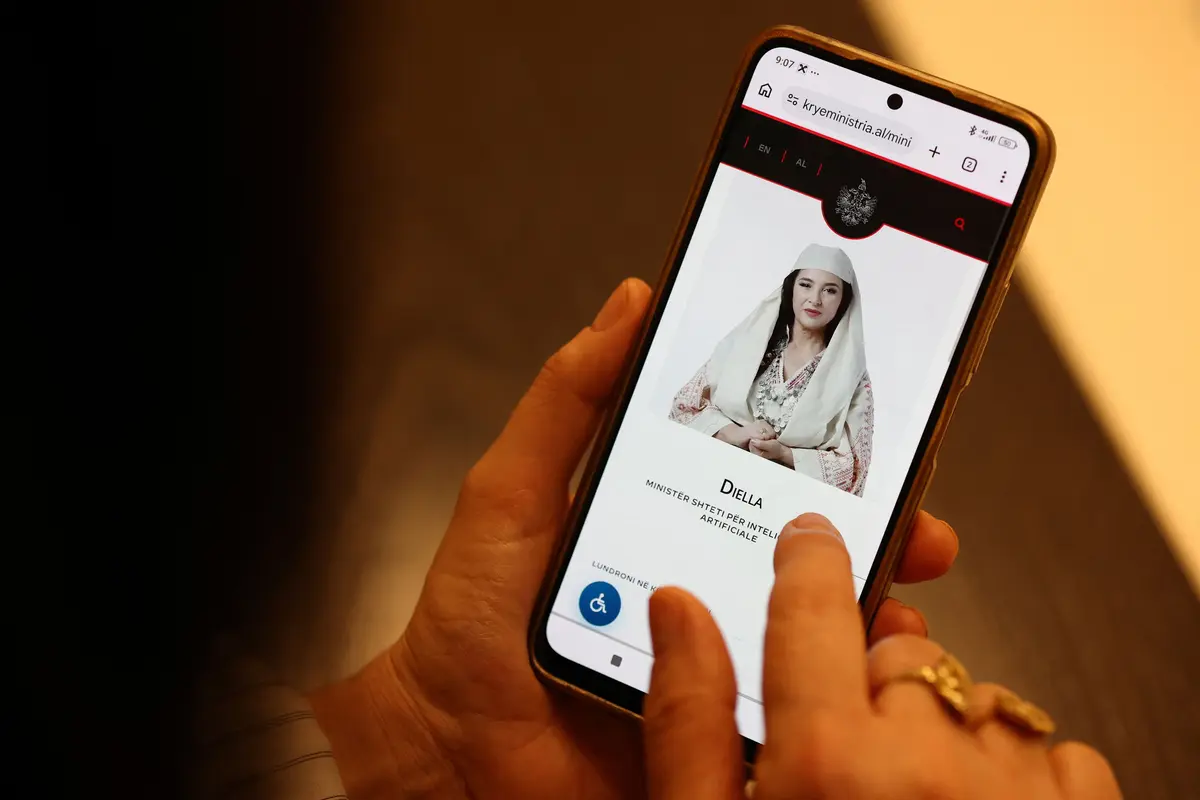
A few months later, Diella received a visual avatar that could speak: an ageless female figure dressed in a traditional costume from northern Albania, with a “glassy” face, helping citizens navigate bureaucracy.
Behind Diella stands the National Information Agency of Albania, AKSHI, which is responsible for the country’s digital transformation and reports directly to Prime Minister Edi Rama. This agency developed the chatbot in collaboration with Microsoft.
However, in December, precisely the agency’s director and her deputy—the creators of Diella—came under the focus of justice. The Special Prosecutor’s Office against Corruption and Organized Crime placed them under house arrest, bringing serious criminal charges: they are suspected of being part of a criminal organization that systematically manipulated public tenders.
According to the indictment, they awarded contracts to close companies and, to eliminate competition, used pressure and threats. There are even reports of kidnapping cases. The media speaks of financial damage of 5 to 10 million euros diverted through these schemes.
The fraud scandal has severely damaged Diella’s credibility. Critics are of one mind: the virtual minister is part of the problematic system, not its solution.
From the beginning, when Rama introduced this novelty, the opposition protested, calling the initiative unconstitutional and propagandistic. Even lawyers and experts raised concerns about the lack of transparency.
-What data feeds the artificial intelligence, and on what criteria does it make decisions.
Its code is not public. There is also criticism over the lack of legal status: no one knows who bears legal and political responsibility in case of wrong or illegal decisions. This creates the risk that politicians or officials could blame artificial intelligence for corruption cases.
Nevertheless, the prime minister is not deterred by criticism. He continues to support the virtual minister. On the government’s official website, Diella is presented as part of the cabinet, just like the real ministers.
Even at the end of October, Rama declared: “Diella is pregnant with 83 children.” These “children” are new chatbots that will serve as assistants for MPs—they will participate in meetings, take notes, and give advice.
Opposition to the project has also come from the woman who gave Diella her voice and face. Albanian actress Anila Bisha has sued the government for unauthorized use of her image.
According to Bisha, the audio and video material she recorded was intended only for the E-Albania chatbot and for a low fee. The contract expired at the end of 2025, and she claims she never gave permission to become the face of the virtual minister.
She turned to the court after the government did not accept her demands for a new contract. Bisha is seeking a halt to the use of her image until the matter is resolved. So far, no action has been taken.
On the other hand, the government spokesperson has described the lawsuit, in a statement to Politico, as absurd.