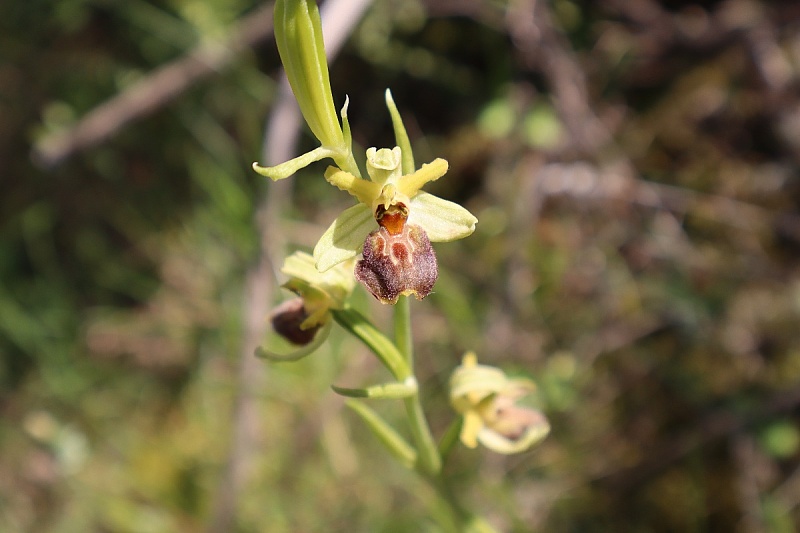
This rare species was identified in the field by Elvedin Šabanović from the "Nature Protection Network of Bosnia and Herzegovina" and Bariša Ilić from the Ornithological Society "Brkata sjenica" from Metković.
The Adriatic orchid is one of nine specific species from the genus Ophrys (family Orchidaceae) recorded so far in our country. These orchids are known in science for their incredible and striking method of pollination.
Namely, their flowers mimic insects in appearance and imitate the sexual signals of female pollinators. Male insects, attempting to copulate with the flower, unconsciously carry out pollination, making this plant genus one of the most interesting examples of evolution in the plant world.
Expansion of the known habitat
The discovery in Blagaj represents the first official finding of this species in Bosnia and Herzegovina, significantly expanding the known range of its distribution. The Adriatic orchid was first described in 1986 on the island of Korčula, and it is a rare plant that inhabits both sides of the Adriatic Sea.
So far, it has been recorded on Croatian islands (Korčula, Cres, Lošinj, Krk), parts of the Dalmatian coast, as well as in Montenegro, Albania, and southeastern Italy.
From the Youth Club "Novi Val" Blagaj, they emphasize that this finding confirms the high biological and ecological value of this area, which is increasingly recognized as an important habitat for rare and insufficiently researched plant species.
"The site is characterized by karst terrain and specific vegetation conditions that enable the survival of sensitive plants. Such habitats often remain insufficiently researched, even though they represent key points for biodiversity conservation," state from "Novi Val".
This discovery further highlights the need for urgent and systematic protection of the natural areas of Blagaj, including the wider area along the Buna and Bunica rivers. These ecosystems are under constant anthropogenic pressure, and new data on the presence of rare species clearly indicate the importance of their long-term and sustainable management.
The finding of the species *Ophrys archipelagi* is considered one of the most significant modern botanical discoveries in Bosnia and Herzegovina, confirming that the natural heritage of the Herzegovinian karst still holds many undiscovered treasures of scientific and conservation importance.