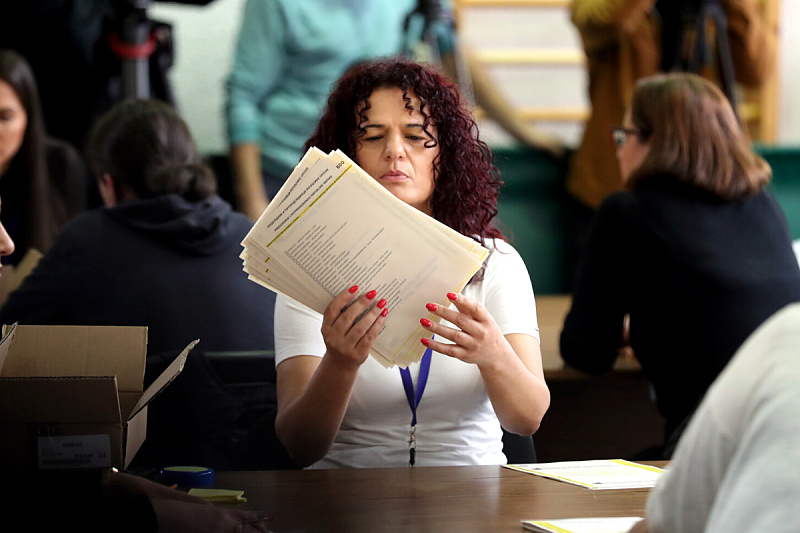
Despite interventions by High Representative Christian Schmidt, disputes over amendments to Bosnia and Herzegovina's Election Law continue to raise questions about the timely holding of elections. The Central Election Commission of Bosnia and Herzegovina has awarded the contract for the procurement of new election technologies to the company Smartmatic, but there is still a deadline and possibility for companies to appeal.
Certain political parties, such as HDZ 1990, have already stated that elections should be postponed until the introduction of new technologies. In a country known for "voting by the dead" as a result of numerous electoral manipulations, this approach would represent an improvement.
Vehid Šehić, a former member of the Central Election Commission of Bosnia and Herzegovina and president of the Strategic Committee of the "Under the Lens" Coalition, believes that biometric voter identification is necessary. "It is important that the introduction of scanners will prevent actions taken by unscrupulous members of polling boards, who often invalidate valid ballots if, in their opinion, they were cast for their political rivals, and unused ballots were also exploited," he emphasized.
Choosing the safest, not just the cheapest bidder When it comes to the bidder, Šehić says that the highest security of the electoral process should be offered, with multiple levels of protection to prevent any hacker intrusions on election day itself. The new technology, he adds, will also enable very fast unofficial preliminary election results. Despite proposals to postpone the elections, Šehić says he sees no reason for such a scenario. "There is a risk that we may not have new technologies on election day itself. It depends on the speed of selecting the most favorable bidders for the procurement of all this equipment, but the CEC will handle that job," he notes.
Šehić emphasizes that it is important to choose the safest, not just the cheapest bidder. When asked about the possibility of postponing the elections, Šehić says everything must proceed in accordance with the Election Law of Bosnia and Herzegovina. The reason could be extraordinary circumstances, such as major natural disasters. If that were to happen, elections would have to be held no earlier than seven days and no later than 30 days from the date of the decision to postpone the elections.
He recalls numerous obstructions, from the allocation of funds to the CEC's account to the signature of the competent minister. "This is proof, for anyone who observes realistically, that some parties are not pleased with the introduction of new technologies," Šehić concluded.
Pandora's box opened Dario Jovanović, director of the "Under the Lens" Coalition, which monitors elections, told Klix.ba that they have been under constant threats and pressures to postpone elections for three consecutive electoral cycles, which has happened on several occasions. "It seems to me that we opened Pandora's box precisely by not always holding elections on the first Sunday in October in previous electoral cycles," he stated.
However, he underscores that these are not normal situations and circumstances for anyone, in whatever way they please, for political reasons or because they have instruments of power, to call into question the holding of elections. He points out that it is possible for elections to be postponed this time as well, which could happen due to the prevention or obstruction of election financing or due to technical impossibilities to carry everything out on time.
But Jovanović emphasizes the necessity of introducing new technologies, and the same commitment is shared by citizens, as seen in the 2022 petition when over 100,000 people declared in favor. Also, according to the latest public opinion survey, 83 percent of citizens support this. "There are almost no statistical differences between ethnic groups, places of residence in this regard, and Bosniaks, Serbs, Croats, people in the RS and the Federation of Bosnia and Herzegovina equally want to see new technologies, and that is what everyone wants when voting," he notes.
The pilot projects conducted with new technologies, Jovanović says, were successfully evaluated.
"Most of it is on the backs of the bidders" Jovanović says he believes that elections will be held in October at all 5,400 polling stations in the country. However, a prerequisite is that the appeal process regarding the selection of the bidder be resolved positively as soon as possible. He believes this will be resolved within the next month.
He explained that the tender is very specific and prescribes a series of tasks that bidders must complete. It is not just about the production of equipment and software adaptation of the equipment, but also about the design of ballots, printing of ballots, delivery, and storage of that equipment... He concludes that most of this will actually be "on the backs" of the bidders, i.e., the company that will deliver the equipment, and not on the election administration.