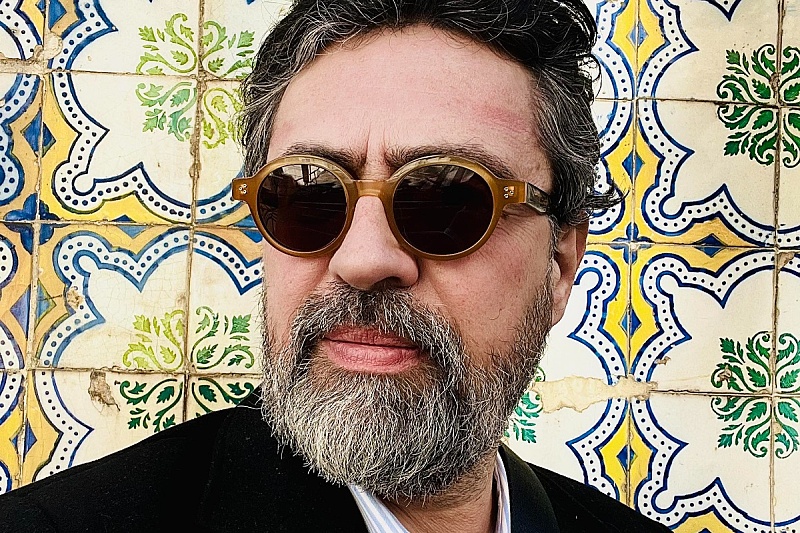
"Someone might say that Skenderija is 'aged.' Well, it is. It's as aged as Generation X, as aged as we are. Skenderija was built in '69. A generation. There are older buildings in Sarajevo that were devastated in the war, in much worse condition than Skenderija—buildings over a hundred years old, from the Turkish and Austrian 'times,' from colonial eras, so to speak—and they were renovated and look like new. Renovated by foreigners: Turkey and Austria, for example. Former colonial masters. They renovated them 'as if they were their own.' But Skenderija is a monument of modern brutalist architecture from the so-called communist era, from a period of true sovereignty, true independence, and non-alignment," he states.
Among other things, he notes that it is symptomatic how these days Skenderija is slowly disappearing as the last relic of social ownership, built through the self-contributions of Sarajevo's residents, while America prepares to finally settle accounts with Cuba.
He emphasizes that there aren't enough Sarajevans left in Sarajevo who still preserve and have the "certificate" proving they paid for Skenderija, that it belongs to them, to take the case to an international or European court or file a collective civil lawsuit.
"Be that as it may, there simply isn't a critical mass—neither globally nor locally—to nurture these achievements, these 'traditional progressive values.' Instead, new, young, and above all entrepreneurial politicians have arrived who see progress differently, who strive to break with the past, especially the self-managing and socialist one, erasing all traces of that time—including steelworks, mines, hydroelectric plants, thermal power plants, power lines, railways, agricultural-industrial combines, once social, now state property. Newer times have come, a newer world order than the one based on anti-fascism—a new heaven and a new earth where everything has its market value, price, barcode. And so, new times arrived in which, like the former firmans from Istanbul, rescripts from Vienna, directives came from today's great centers of power, whose periphery we now are. A new wind blew, and we bent at the waist and bowed, not to say something else," Nikšić stated.
He also leveled specific criticism at the government, of which he himself was once a part.
"It is painful to watch this government, of which I was a part, in whose rise I myself participated over the past eight years, believing it to be a progressive government (certainly more progressive than the previous conservative one), as it flounders these days like a fly in a spider's web, 'like a chick in the talons of a hawk,' desperately and subserviently appealing to numerous neocolonial masters, prostituting the country and its heritage to predatory 'investors' at all levels. I'm not saying the conservatives wouldn't do the same if they were in their place. On the contrary. I think that if and when the conservative coalition returns to power in full force—it will be much worse," Nikšić warns.
Nevertheless, he says, he wants to note that it is painful for him to watch "progressive parties and parties of the ruling coalition how they have 'laid down on the tracks' and been tasked with delivering, by the end of their mandate, to (foreign) private companies and corporations what they promised the citizens in their election campaigns they would defend and preserve."
"Such times have come. Times of hypocrisy and duplicity. Everyone swears by sovereignty, yet sovereignty is disappearing before our eyes. In other words: each speaks of what concerns them—a harlot of honor and honesty, and Bosnian-Herzegovinian politicians of independence and sovereignty," he concluded.