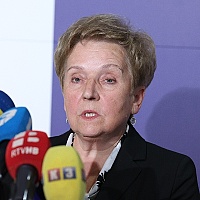
Pendeš stated that she "likes the map presented" and announced that a similar event would soon be organized in the institutions of Bosnia and Herzegovina.
Responding to a journalist's question about how she views the labeling of BiH as a "failed state" and a threat in the capital of a neighboring country, Pendeš defended the gathering, emphasizing that the idea did not originate solely from Zagreb, but that representatives of Croats from Bosnia and Herzegovina also participated in its organization.
"I wanted to organize such a conference here in the Blue Hall of the House of Peoples of the Parliamentary Assembly. And I really like the map that was presented. That map shows ethnic cleansing. It doesn't show a third entity, my dear friends, but ethnic cleansing of 250,000 Croats since 1991," Pendeš stated.
She added that the event was organized in Zagreb primarily due to fears that its holding in Sarajevo would not be approved. Pendeš took the opportunity to openly express dissatisfaction with the current state structure.
"If anyone is satisfied with the Dayton Peace Agreement, the Croats are not satisfied. The Croats were satisfied when they went to the referendum and gave their vote for a unified, indivisible Bosnia and Herzegovina, a state of three constituent peoples. Do we have that? We don't. Where are we? It can be seen from the enclaves. Analyze how many of us suffered percentage-wise in the past war and how many of us are missing since 1991. And then someone says 'we are very satisfied with Dayton and the Republika Srpska.' I am not," said the HDZ representative.
When asked whether dissatisfaction with the position of the Croatian people is the reason for holding such conferences, she answered affirmatively and took on the obligation to bring a similar story to the building of the BiH Parliament.
"Of course. As the president of the Club, I take on the obligation to hold such a conference here, in the Blue Hall. I will also invite you journalists to participate together, with critical and any other commentary, and before that, we will prepare a detailed analysis," Pendeš concluded.
What happened at the conference in Zagreb
Marina Pendeš's statements come as a reaction to the two-day gathering "TradFest" held last weekend in Zagreb, which sparked harsh condemnations in the BiH public due to its interference in the internal structure and territorial integrity of Bosnia and Herzegovina.
The conference was organized by the ultra-conservative associations Vigilare and Ordo Iuris Croatia, with the support of the American think tank Heritage Foundation.
Particularly scandalous was the panel titled "BiH: a failed state and the necessity of a third Croatian entity." At it, Ivan Pepić from the "Dr. Franjo Tuđman" University of Defense and Security presented a model of territorial reorganization under which BiH would be divided into the Republika Srpska, a "Croatian republic," a "Bosniak-Muslim republic," and the Brčko District. On the presented map (which Pendeš also referred to), the so-called "Croat Republic" would encompass western Herzegovina, the Mostar area, and separate units in central Bosnia and Posavina.
The gathering also featured a speech by Cardinal Vinko Puljić, the retired Archbishop of Vrhbosna, who highlighted the dysfunctionality of the system and the unequal position of Croats, but added that these issues should be resolved at a political, not a church level.
The gathering also faced condemnations from parts of the Croatian public. Armin Hodžić, a representative of the Bosniak national minority in the Croatian Parliament, accused the participants of transferring "Dodik's rhetoric" to Croatia, asking how it would be if a conference on "failed France and its territorial reorganization" were organized in Germany.
On the other hand, parliamentary representative Nino Raspudić defended the gathering, claiming it was a discussion about the survival of BiH. Additional tensions were caused by the presence of Domagoj Knežević, an advisor to the Croatian Minister of Foreign Affairs Gordan Grlić Radman, which was interpreted as tacit political support from official Zagreb for such ideas.