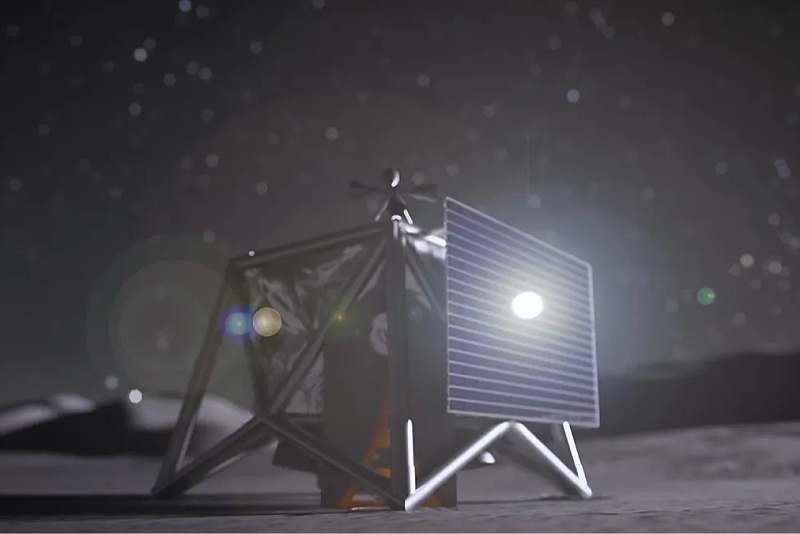
Last month, NASA chief Jared Isaacman broke his silence on the space agency's plans to return to the Moon, calling for a major overhaul of NASA's Artemis program. One of his announcements was a rapid series of robotic missions to scout, conduct experiments, and prepare for surface operations before any "restart" of lunar exploration by astronauts in 2028.
As part of NASA's Ignition event held on March 24, Isaacman called for the removal of unnecessary obstacles hindering progress, stating that the agency would "unleash the workforce and industrial power of the nation" to return to the lunar surface and build a base on the Moon.
One aspect of the Artemis restructuring involves the use of "hopper" drones under what is called MoonFall. A request for proposals to move MoonFall forward was released on the day of NASA's Ignition event. The question arises: what exactly does this project entail, why now, and what comes next to get this initiative off the ground...
Ray Baker is the project lead for MoonFall at NASA's Jet Propulsion Laboratory in Pasadena, California.
MoonFall involves launching four "drones" equipped with cameras and sensors above a yet-to-be-selected location on the Moon's south pole, Baker revealed to Space.com.
"Our goal is for each drone to cover a range of approximately 50 kilometers and to achieve this by the end of 2028," he said.
These drones are powered by the same knowledge and bold spirit that enabled the Ingenuity Mars helicopter to perform 72 flights during the Perseverance rover mission, which is now operating in Jezero Crater on the Red Planet.
"We will stand on their shoulders. We will combine our success from Ingenuity—all that knowledge, all that skill, and that success—with industrial capabilities. We will succeed in this," Baker said.
One thing that differs from the past but is rapidly evolving is the consideration of the new and growing space industry.
"They have many capabilities, and that is something we will heavily rely on and leverage, alongside our JPL capabilities," Baker said.
The Ingenuity Mars helicopter was filled with standard commercial electronics, much of which is typical of what can be found in mobile phones, but it also had built-in smart features for detecting and avoiding hazards as it "hopped" from one part of Mars to another.
Similarly, the MoonFall drones, which "hop" from place to place, will each assess what they can see as they approach their landing sites and land in the safest local area.
Things are moving quickly for MoonFall.
"We look forward to selecting our industrial partners and completing this. It will be a truly exciting journey. We hope that by June of this year, our primary partners will be selected," Baker said.
Looking ahead, prototype hardware for MoonFall is already in preparation or now under development.
"We have development milestones later this year that include indoor tests carrying engineering hardware to verify navigation and control sensors," Baker announced.
Spacecraft integration and testing are planned for late summer 2027, with delivery of MoonFall to the launch site scheduled for 2028.
"It will be a fast pace. We believe we can do it," he said.
It is not clear how much the MoonFall project will cost.
"NASA is still working out the details on costs and budget, so we cannot provide those details yet, but we are confident that, in partnership with industry, JPL has the skills and technology to deliver on time," Baker emphasized.
Deploying drones during descent over the Moon is highly beneficial, as it avoids the additional costs and risks of a fully powered landing vehicle.
Additionally, the mission will leverage industrial capabilities for the transfer and braking phase, as well as the mechanical and propulsion systems of the drones. As such, this mission aligns well with NASA administrator's goals to reduce costs.