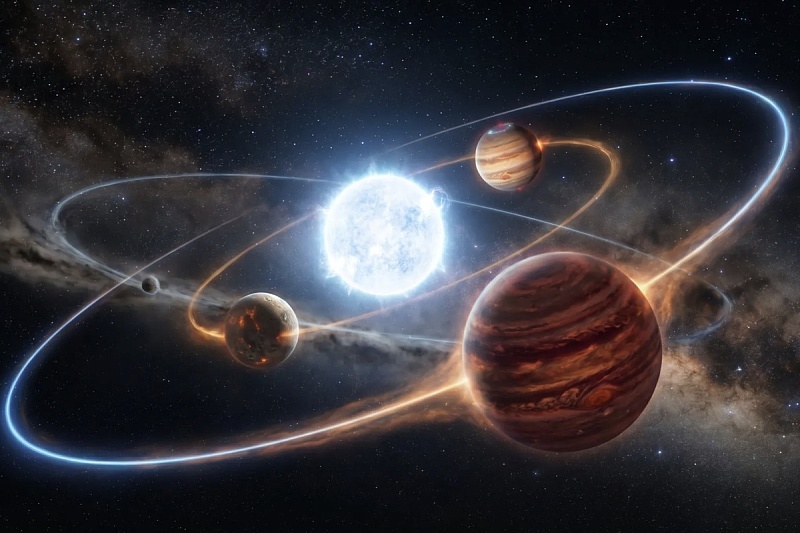
Extrasolar planets, or exoplanets, orbiting the star TOI-201 have orbits that change so rapidly that astronomers can observe the changes in real time. The behavior of this system, located about 370 light-years from Earth, is something scientists have never seen before. TOI-201 has 1.3 times the mass of the Sun and also has a diameter 1.3 times that of our parent star. The exoplanets orbiting the star include a rocky super-Earth with six times the mass of our planet, whose year lasts only 5.8 Earth days. Its planetary companions include a gas giant with half the mass of Jupiter, which completes an orbit every 53 days and is designated TOI-201b, as well as another gas giant that has 16 times the mass of Jupiter and completes an orbit every 2,883 days (about 7.9 years). "Most planetary systems look like 'peas in a pod,' meaning the planets have a similar range of parameters and share a similar orbital plane. That is not the case in the TOI-201 system, which contains three orbiting objects that are very different from each other and that interact gravitationally," said team member Amaury Triaud from the University of Birmingham in the UK. Changes in planetary systems and orbital shifts are not unique to TOI-201, but these transformations typically occur on timescales of millions or even billions of years. TOI-201 stands out due to the highly flattened or elliptical and tilted orbit of its outer planet, which gravitationally tugs on the inner worlds. This causes changes in the orientation of the inner planets' orbits and variations in the timing of their "transits," the moments when a planet directly crosses the face of its parent star. The situation is so extreme that in about 200 years, the planets will no longer align in front of their star at all. "In the solar system, almost all planets are coplanar, but here that is not the case, and each planet is different. This indicates some active orbital reorganization within the system, providing us with insight into what happens soon after planet formation," said Tristan Guillot, an astronomer at the Côte d'Azur Observatory. Guillot is the lead researcher on the ASTEP project, an observatory at the Concordia station in Antarctica, located atop a 3.2-kilometer-deep glacier in one of the most isolated environments on Earth, using the long polar nights to observe other planetary systems. "The goal was to characterize the TOI-201 planetary system to understand not only which planets exist, but also how they dynamically interact with each other. This helps scientists understand how planetary systems like our solar system form and evolve over time," said research team leader Ismael Mireles, a doctoral student at the University of New Mexico. TESS spotted a rare transit of the outer planet, while telescopes around the world observed the gravity of this object pulling on TOI-201. Astronomers then noticed delays in the transit of TOI-201b. "Usually, planets are like metronomes, where each transit in front of the star occurs exactly one orbital period after the next. However, we were monitoring TOI-201b, and suddenly the planet began transiting with a delay of about half an hour. This sudden jump was very surprising, and we reported our observations. Other astronomers around the world also noticed intriguing signals, and by working together, the team was able to begin understanding this system. This discovery was made possible by having a telescope in Antarctica. Although the logistics involved are challenging, its unique location and access to optimal astronomical conditions are crucial for studying exoplanetary systems with long orbital periods like TOI-201," concluded Triaud.
Society
NASA's TESS spacecraft discovers a strange exoplanet system unlike any seen before
Using NASA's exoplanet-hunting spacecraft TESS (Transiting Exoplanet Survey Satellite) and the Antarctic Search for Transiting ExoPlanets (ASTEP) observatory on the Antarctic Plateau, astronomers have discovered a rare and uniquely unusual planetary system.
ingestion