The conference was organized in collaboration with the ultra-conservative associations Vigilare and Ordo Iuris Hrvatske, with support from the American think tank Heritage Foundation, which is linked to circles close to U.S. President Donald Trump.
Particular attention was drawn by a panel titled "Bosnia and Herzegovina: A Failed State and the Necessity of a Third Croatian Entity," which sparked sharp criticism from Bosnia and Herzegovina even before the event. Numerous media outlets and analysts deemed it scandalous that the internal reorganization of Bosnia and Herzegovina was being discussed in the capital of a neighboring country, emphasizing that this is the exclusive jurisdiction of its institutions and citizens.
One of the speakers was Cardinal Vinko Puljić, retired Archbishop of Vrhbosna, who stated that he cannot accept injustice but that a "path of the possible" must be sought due to, as he noted, the dysfunctionality of the system and the unequal position of Croats as a constituent people. He added that issues of political organization should be resolved at the political level, not the church level.
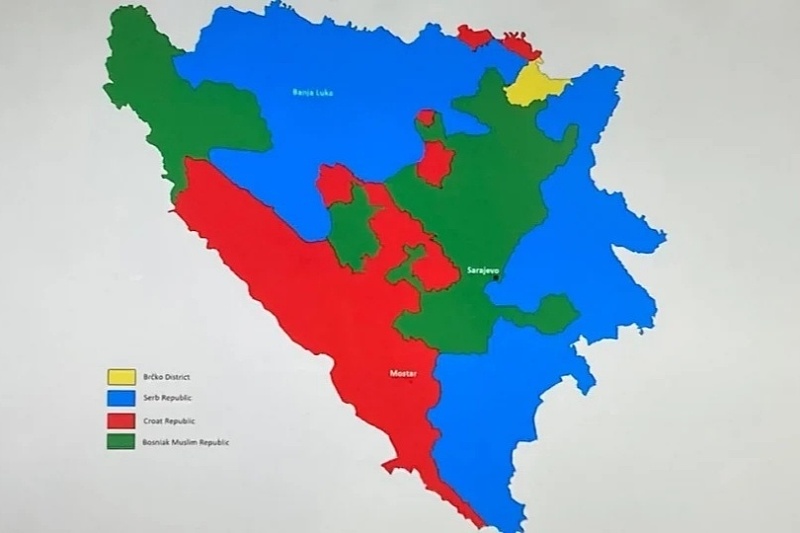
The most controversy was sparked by the presentation of Ivan Pepić from the "Dr. Franjo Tuđman" University of Defense and Security, who presented a model for the territorial reorganization of Bosnia and Herzegovina. According to this proposal, the country would be divided into the Republika Srpska, a "Croatian republic," a "Bosniak-Muslim republic," and the Brčko District.
The map displayed prominently marked a so-called "Croat Republic," which would encompass western Herzegovina and the Mostar area, along with separate territorial units in central Bosnia and Posavina. Pepić stated that such a model, modeled after Belgium, could ensure equality among constituent peoples.
These proposals provoked strong reactions, with Armin Hodžić, a representative of the Bosniak national minority in the Croatian Parliament, describing the gathering as an "event on the margins of the political spectrum" and accusing participants of transferring Milorad Dodik's political narrative to Croatia.
"Imagine a conference being organized in Germany titled 'Failed France and Its Territorial Reorganization.' That would be unthinkable," Hodžić said.
On the other hand, parliamentary representative Nino Raspudić stated that this was not an attempt to break up Bosnia and Herzegovina but a discussion about its survival while ensuring equality among peoples.
Additional reactions were triggered by the presence of Domagoj Knežević, special advisor to Croatian Foreign Minister Gordan Grlić Radman, which some commentators interpreted as a signal of political support for the gathering.
The Party of Democratic Action (SDA) also reacted to the conference, strongly condemning the event and stating that under the guise of discussing the position of Croats in Bosnia and Herzegovina, ideas of ethno-territorial divisions were being promoted again.
In a statement, they warned that such proposals resemble maps from the 1990s, which, as they noted, were not an "academic exercise" but a prelude to policies that resulted in serious crimes.
As they said, these constructs irresistibly resemble maps drawn in the early 1990s, on the eve of the aggression against Bosnia and Herzegovina.
"Those maps were not an academic exercise, nor a harmless political fantasy. They were a prelude to policies whose proponents were convicted before the International Criminal Tribunal for the former Yugoslavia for participation in a joint criminal enterprise. Therefore, any new drawing of ethnic borders in Bosnia and Herzegovina represents a dangerous political message, a direct blow to the sovereignty and territorial integrity of our state, and a gross insult to the victims of policies that attempted to realize such projects," the SDA statement said.
As they added, Bosnia and Herzegovina is no one's space for ideological experiments, geopolitical projections, or neighborly fantasies about "reorganization."
"Its internal organization can only be a subject of discussion within the institutions of Bosnia and Herzegovina, in accordance with the Constitution, laws, and the democratic will of its citizens and peoples. The Republic of Croatia, as a member of the European Union and NATO, has a special responsibility to respect the sovereignty of Bosnia and Herzegovina. One cannot speak of a friendly relationship with Bosnia and Herzegovina, a European future, and good neighborly cooperation while simultaneously hosting events where the sovereignty of Bosnia and Herzegovina is questioned and maps of new ethnic divisions are promoted," the statement added.
They emphasized that the lack of reaction from the state authorities of Bosnia and Herzegovina is also concerning.
"The silence of institutions, especially those led by cadres from pro-Bosnian parties, in the face of such provocations represents a worrying political and diplomatic failure. This silence is being attempted to be concealed by deliberately diverting public attention to ephemeral topics, while in a neighboring country, new divisions of Bosnia and Herzegovina are being publicly discussed. A state authority that remains silent while new maps of divisions in Bosnia and Herzegovina are being drawn in the neighborhood should step down because it is not prepared to consistently protect the interests of the state," the SDA statement emphasized.