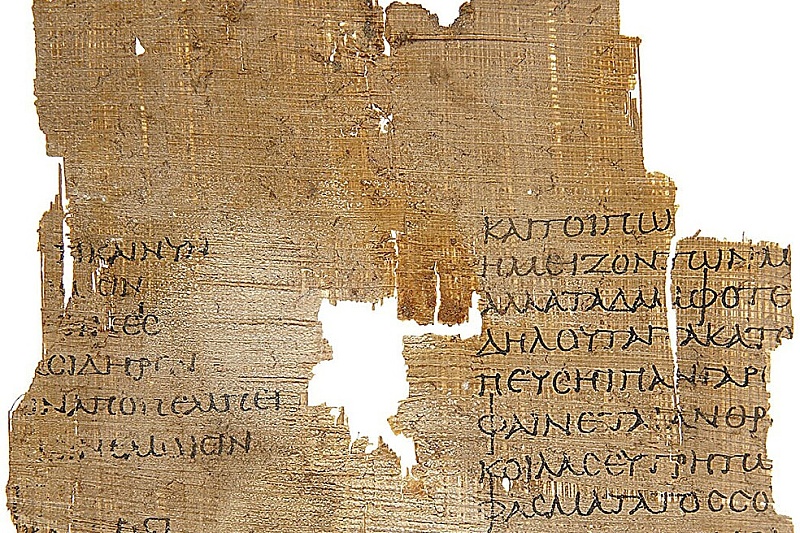
A fragment of papyrus was discovered in the archives of the French Institute of Oriental Archaeology in Cairo, and papyrologist Nathan Carlig from the University of Liège determined that the manuscript, designated as P. Fouad inv. 218, is an unknown portion of the work *Physica*, a poem written by Empedocles.
According to a university statement, Empedocles' work had previously been known only through quotations recorded by later authors, including Plato, Aristotle, and Plutarch. The newly identified verses deal with the philosopher's reflections on the emission of particles and sensory perceptions, particularly vision, reports Archaeology.org.
Carlig and his colleagues believe that the newly discovered material could change Empedocles' place in the history of philosophy.
They suggest that these verses could more clearly position him as a precursor to the ancient Greek atomists, who argued that the universe is composed of fundamental components that are indestructible, unchanging, and too small to be seen.