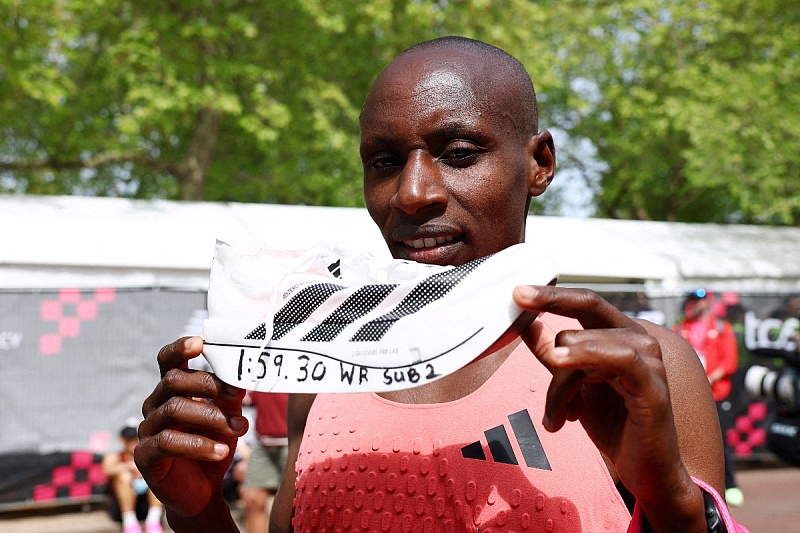
"I showed them that nothing is impossible," he said after finishing the race in one hour, 59 minutes and 30 seconds, adding: "Today I was ready... I am very happy because I had a lot of courage to push, even when the pace was fast. That is something not to be forgotten, something to remember, and it will stay in my memory forever."
Second place went to Ethiopian Yomif Kejelcha (28), just 11 seconds behind him. Besides passion and pure dedication to their sport, Sawe and Kejelcha had something else in common: their choice of footwear that day. Weighing just 97 grams, Sawe predicted before defending his London title that the Adidas Pro Evo 3s could be a record-breaking pair.
The shoes were also worn by Tigst Assefa, who defended her title at the London Marathon in a women's-only world record of two hours, 15 minutes and 41 seconds. With an average weight of just 97 grams per shoe, the Adizero Adios Pro Evo 3 follows what Adidas describes as "three years of cutting-edge research."
To put the shoe's weight into perspective, one of these shoes weighs about as much as an average bar of soap, and slightly less than a Cadbury's Dairy Milk bar. Adidas says the Pro Evo 3 is "30 percent lighter, provides 11 percent more energy return to the forefoot, and improves running economy by 1.6 percent compared to its predecessor."
The German sportswear brand says this gives the shoe the potential to break records "before the laces are even tied." The Lightstrike Pro Evo foam embedded inside the shoe weighs 50 percent less than previous versions, Adidas says, adding that "with a stack height of 39 millimeters, it maximizes cushioning, propulsion, and energy return with every step."
ENERGYRIM, a thin carbon fiber cutout that wraps around the shoe's perimeter, is also a key component, Adidas says, supporting the maximum foam volume underfoot "while providing precisely tuned stiffness for stability."
"This unique interaction of foam and carbon redefines energy return, propulsion, and efficiency in super shoes," the brand states, adding: "Even the smallest components, from laces to stitching, have been obsessively refined to achieve marginal gains that make a difference on race day. A more efficient outsole design, with strategically placed Continental rubber on the forefoot to ensure reliable grip at high speeds, without compromising weight."
With a retail price of €520 online, the Adizero Adios Pro Evo 3 is not cheap. With such a high price tag, one might expect to get many kilometers out of the shoe, but when it comes to so-called "super shoes" designed for elite athletes, marginal gains seem to outweigh sustainability.
In a post related to the Pro Evo 1 from 2023, the environmentally focused club Green Runners wrote an open letter to Adidas CEO Bjørn Gulden, expressing concern about the marketing of the shoes as disposable.
"For years, people have been fighting against single-use plastic. And slowly, too slowly, governments are paying attention," the group wrote, adding: "But who would have thought that a major sports brand would have the audacity to sell single-use running shoes? We didn't. But perhaps we should have seen it coming. Over the past few years, the race for the fastest shoe has reduced the lifespan of racing shoes. And now you give us the Adizero Adios Pro Evo 1, a shoe designed to last for one marathon race. By promoting these shoes, you risk creating a new normal. Accepting that people should not expect to get many kilometers out of their running shoes."
In a statement to the outdoor activities website Outdoors Magic, an Adidas spokesperson said the Adizero Adios Pro Evo 1 was designed with one purpose: to deliver our best materials and technologies on race day in our lightest long-distance shoe ever.
"We tested the shoe with a range of athletes over different distances, and while it is not designed with the same longevity as other shoes in our Adizero line, we and our athlete partners are confident in its performance," he said.