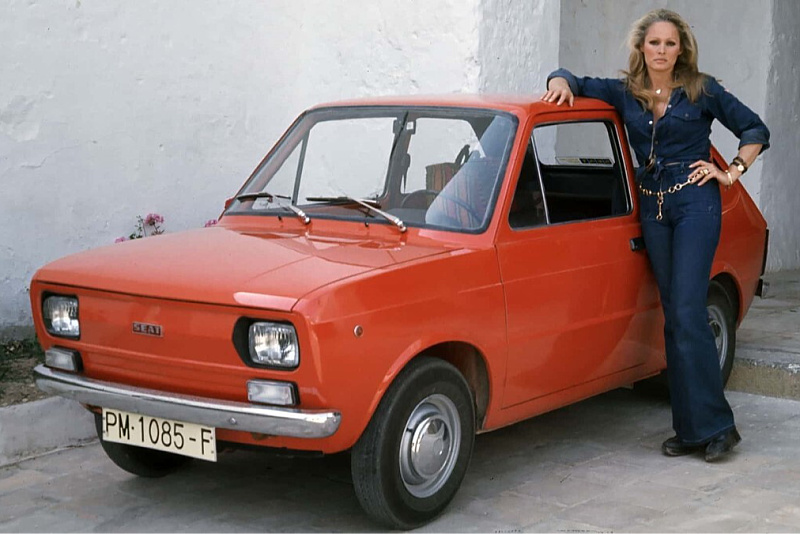
The Seat 133 was created with a single clear goal – to be as cost-effective as possible, both in development and production. That’s precisely why the designers didn’t reinvent the wheel: the chassis and engine were taken directly from the Seat 850, or rather the nearly identical Fiat 850, resulting in a car that somewhat resembles a fruit mix – various ingredients from different models combined into one whole. The model replaced Seat’s previous successful series – the 850 and the legendary 600, of which around 800,000 units were produced by 1974, almost exclusively for the domestic market. In terms of size, it was a model halfway between the Fiat 126 and the Fiat 127, visually resembling the big brother of the smaller one, known in our region as the "Peglica." However, the first oil crisis erupted six months before its debut. People in Western Europe suddenly realized they needed a small, economical car. By the time production of the 133 began, Seat already had 30,000 employees, 1,900 cars were rolling off the assembly lines daily, and among them was the two-millionth model since the company’s founding.
Technical Specifications The Seat 133 is a small two-door car with four seats, a rear-mounted engine, and rear-wheel drive – a concept that by the mid-1970s was slowly fading into history, giving way to front-wheel-drive models like the Fiat 127, Renault 5, or Audi 50. Its design resembled the Fiat 126 but was about 40 cm longer, equipped with a classic water-cooled engine. Like many other rear-engine cars, the 133 had two trunks: a larger one with a capacity of 180 liters at the front and a smaller one, just 40 liters, behind the rear seats. Unlike the Seat 850, the rear seats could not be folded down. In terms of dimensions, the car is 3,451 mm long, 1,421 mm wide, with a wheelbase of 2,027 mm, a curb weight of 690 kg, a payload of 320 kg, and a 30-liter fuel tank. The heart of the car is a four-cylinder engine with a displacement of 843 cc, mounted longitudinally at the rear and paired with a four-speed manual transmission. It came in three variants: Normal with 34 hp and drum brakes, Super with 37 hp and increased compression, and the most powerful – L Special – available exclusively for the Spanish market – with 43 hp, dual carburetors, front disc brakes, and a top speed of 139 km/h. The front suspension consisted of classic wishbones with transverse leaf springs and an anti-roll bar, while the rear used independent suspension with coil springs and a rear anti-roll bar. The steering was of the worm type with a very direct ratio of just 2.8 turns from lock to lock. It’s also worth noting the compression ratio of only 8:1, which allowed the car to run on gasoline as low as 85 octane – acceptable in Spain but already somewhat outdated in the rest of Western Europe.
Sales and Exports with the Help of a Bond Girl Initially, Seat sold the 133 only in Spain – without much success. The early period wasn’t ideal – the 133 often suffered from overheating issues. Nevertheless, Seat aimed higher, and it will be remembered that they hired Ursula Andress to give the little Spaniard international attention. At the time, it was common for car manufacturers to use famous actresses and models to attract media attention, create an emotional connection with buyers, and "elevate" the status of affordable cars. After her role in the film *Dr. No*, where she played a Bond girl, Andress became a global symbol of glamour and allure. The scene of her emerging from the sea in a shell bikini became one of the most iconic movie scenes of all time. Seat simply wanted the cheap car to appear more glamorous, desirable, and attractive on the international stage. As a result, the export share grew to 36.7 percent by 1976, and by 1980, total Spanish production reached 200,000 units. In foreign markets where the Seat brand wasn’t well-known, the car was sold as the Fiat 133 – in the UK from June 1975 and in Germany from the same year – with a total of around 127,000 units exported.
Global Reach, End of Production, and Trivia The Seat 133 also reached far beyond Europe. In April 1977, an assembly contract was signed at the Egyptian Nasr Automotive Manufacturing Company plant in Helwan, making Egypt the 32nd car-producing country in the world. Between 1977 and 1982, the model was also produced in Argentina – first at the IAVA factory, then at Sevel Argentina – totaling about 15,821 units. In the mid-1980s, Seat halted production of the 133 in favor of the new Seat Panda/Marbella. But the little Spaniard wasn’t forgotten – it long remained a favorite in Finland’s low-budget motorsport known as Jokamiesluokka (abbreviated as Jokkis) – a folk car rally for everyone, where in some seasons more than 30 percent of drivers sat behind the wheel of the Fiat 133.