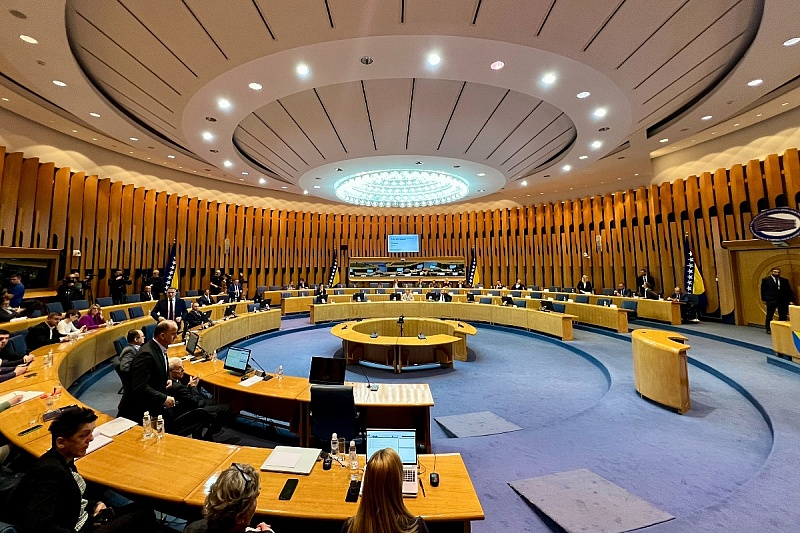
The agenda is expected to include, among other items, a request from the House of Representatives to consider the Proposal for a Law on Amendments to the Excise Law in Bosnia and Herzegovina under an urgent procedure.
The proposed law stipulates that in the event of market disruption or other justified reasons, the Council of Ministers of Bosnia and Herzegovina may adopt a decision to temporarily abolish or reduce the excise duty on petroleum derivatives. The decision would be made for a maximum period of six months within a single calendar year.
On March 16, the House of Representatives adopted, under an urgent procedure, the proposal for this law, whose proponent is MP Saša Magazinović.
Deputy Chair of the House of Peoples Nikola Špirić (SNSD) previously announced that he, along with SNSD delegates Sredoje Nović and Radovan Kovačević, would not attend this session. He stated that Ademović has already attempted several times on his own initiative to schedule a session of the House of Peoples.
Delegate in the Serbian People's Club in the House of Peoples Želimir Nešković (SDS) said it is high time to end this political spectacle in which these Serbian delegates do not attend sessions and prevent the reduction of excise duties on fuel, thereby failing to help household budgets.
The House of Peoples is also expected to consider today a request from the Council of Ministers of Bosnia and Herzegovina to review the Proposal for a Law on Restricting the Disposal of Assets with the Aim of Preventing Terrorism, Financing of Terrorism, and Financing the Proliferation of Weapons of Mass Destruction under an urgent procedure.
The proposed law, prepared by the Ministry of Security in cooperation with relevant institutions, addresses a key systemic deficiency identified in the report of the Committee of Experts on the Evaluation of Anti-Money Laundering and Counter-Terrorist Financing Measures (MONEYVAL), which in December 2024 assessed that Bosnia and Herzegovina lacks a functional and complete system for implementing international financial sanctions.
One of the proposed agenda items is also a request from the House of Representatives of the Parliamentary Assembly of Bosnia and Herzegovina to consider the Proposal for a Law on Amendments and Supplements to the Election Law of Bosnia and Herzegovina under an urgent procedure.
The House of Representatives adopted the proposal for this law in December last year, whose proponents were SDA MPs Šerif Špago, Edin Ramić, Safet Kešo, Amor Mašović, Nermin Mandra, Šemsudin Dedić, Denijal Tulumović, and Midhat Čaušević.
They stated that the adoption of the law on amendments and supplements to the Election Law of Bosnia and Herzegovina would enable the introduction of new electoral technologies into the electoral process in Bosnia and Herzegovina, which will be applied in the next general elections.
This includes biometric voter identification, scanning of ballots, as well as electronic transmission of scanned ballot results, which will enable much faster and more efficient obtaining of results after election day.
Delegates are also expected to consider the principles (first reading) of the Proposal for a Law on the Regulator, Transmission, and Electricity Market in Bosnia and Herzegovina, proposed by the Council of Ministers of Bosnia and Herzegovina.
The Council of Ministers of Bosnia and Herzegovina established the proposal for this law, marked with the EI designation, as confirmation of appropriate compliance with EU regulations in this area.
The goal of the law is to transpose 16 EU directives and the Electricity Integration Package, with a focus on creating an orderly wholesale electricity market and establishing an electricity exchange in Bosnia and Herzegovina, thereby fulfilling one of the prerequisites in this area for our country's exemption from the application of the Carbon Border Adjustment Mechanism (CBAM).