You sit in the new BMW iX3, press a button, take your hands off the steering wheel, and the car continues driving on its own. The screen displays City Assistant (or Highway Assistant), depending on where the system is needed and active. City Assistant starts the vehicle on its own, recognizes traffic lights, stops, and moves again when the light turns green. At first, it sounds like a movie, but it doesn't feel like the future, because every manufacturer is developing similar solutions that work. However, a question arises: is this the end of driving tests and driver's licenses? Why would anyone need to prove they can steer, start on a hill with a handbrake, or park, if the car does it all on its own? Perhaps the answer isn't just in technology. It lies in what happens when technology fails or refuses to assist for some reason—one of which could be if the camera detects you looking at your phone while driving and you ignore the warning. Such a "reprimand" already exists, for example, in the new iX3, which at that moment disables the assistance system and requires the driver, as a form of "penalty," to drive manually for 30 minutes. Contradictory, isn't it? Autopilot isn't a real driver The automotive industry has classified autonomous driving into five levels. At level one, the car only maintains distance from the vehicle ahead—something we've seen for nearly 20 years. At level five, there's literally no steering wheel. Between these two extremes lies everything you can buy in a showroom today and the room for progress toward the final level. Tesla Full Self-Driving, BMW City/Highway Assistant, GM Super Cruise—all operate at level two or three. This means: the car drives autonomously, but you are still legally and physically responsible for everything that happens. A camera tracks your eyes, and sensors measure pressure on the steering wheel. If you look away for too long, the car starts warning and slowing down. This system will be mandatory in all new cars from summer this year, and some models already have it. The only car that can legally drive without a driver under certain conditions today is the Mercedes S-Class with the Drive Pilot system—and only on German highways. In December 2024, Mercedes received certification for an updated version of the Drive Pilot system that works at speeds up to 95 km/h. The system covers the entire German highway network, all 13,191 km, and when active, the driver is legally allowed to watch a movie, read, or do something else. However, if the driver doesn't take control even after a warning, the system autonomously stops the vehicle and activates hazard lights, meaning that even at level 3, the system isn't "infallible"—just more advanced and responsible. Mercedes' goal is to reach 130 km/h by the end of this decade, which is currently the legal maximum for autonomous driving in Germany. The algorithm doesn't know about fog on the road or who is at fault when it makes a mistake Autonomous systems learn from data. Millions of kilometers of recorded roads, marked lanes, known traffic lights. The problem is that real-world roads don't always look like the database: erased lines, roadworks, temporary signs, a flock of sheep crossing a highway, pedestrians running across a fast road, etc. Every time the system encounters a situation it hasn't been trained for, it must hand control over to someone. And that someone must know how to drive, must be ready, and must have reflexes. That's exactly why the test exists—not to prove you can drive on an ideal road, but to adapt and survive the bad one with all those challenges and obstacles. Behind every traffic accident lies the question of responsibility. In a classic collision, the answer is usually clear. With an autonomous vehicle, it's not. Is the car owner at fault, the manufacturer, the team that wrote the code, the company that collected the data, and so on, ad infinitum. The legal systems of the European Union are only now adopting frameworks to regulate level 3 vehicles. Levels 4 and 5 are currently legally uncharted territory. As long as it's not clear who is responsible for damages, no one will sign off on abolishing driver's licenses. Training and testing will change, but they won't be abolished In Finland and Sweden, driver education already includes modules on assistance systems—when to trust them, when not, and how to take control at the necessary moment. That's the direction driving tests are heading: not less demanding, but with different and updated regulations. The paradox of autonomous driving is precisely this: the more capable the car, the more dangerous it is to sit in it without understanding its limits. Research shows that drivers who overly trust assistance systems react slower in critical moments than those who drive without any automation. The technology meant to protect us could cost us our lives. Perhaps in 10 years, some cities will have zones where licensed autonomous cars drive completely on their own, and a license truly won't be needed. But even there, a driver's license will likely remain—as a condition for leaving that zone. For the rest of the world, including our region, the calculation is simple: the average car on the road is over 17 years old. Infrastructure is built slowly. Laws change even slower. The driving test is not facing abolition; it can only possibly undergo reform.
Society
Cars are increasingly driving themselves: Will we need driving schools and training in the future?
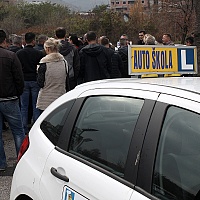
Modern cars today drive on roads and through roundabouts without hands on the steering wheel or foot on the gas, staying in their lane, maintaining distance, and parking without a driver. Despite this, the driving test has never been further from being abolished, even though technology suggests otherwise.
ingestion